

Key Takeaways
- Pre-commitment beats willpower: Setting loss limits online casinos provide is not about restricting fun; it is about using your rational “Cold State” to protect you from your emotional “Hot State.”
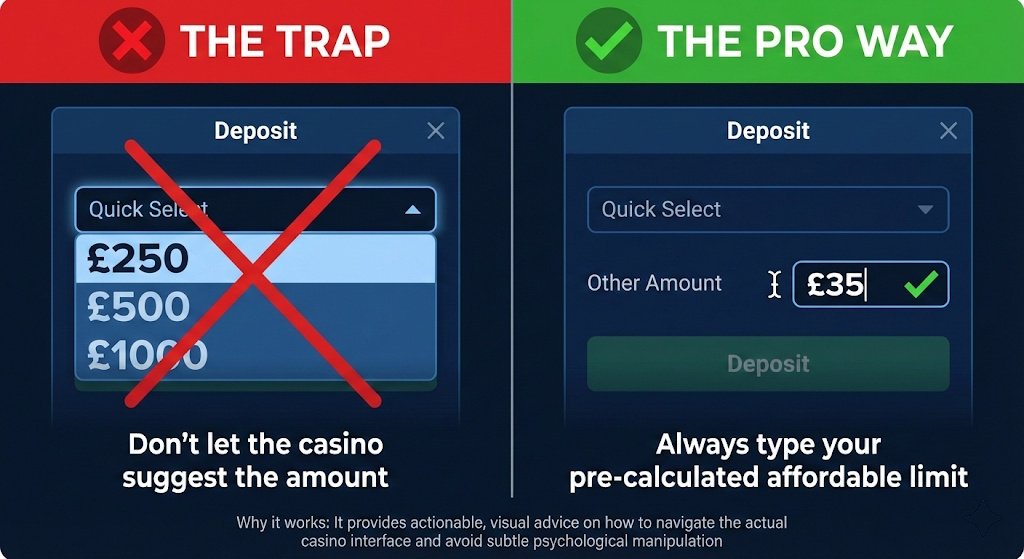
- Avoid the “Anchoring” trap: Casinos often use dropdown menus to suggest higher limits. Always use the free-text box to type the exact figure calculated from your disposable income.
- Know the difference: A deposit limit controls what goes in; a loss limit controls what goes out. Understanding how net losses are calculated is vital for effective bankroll management.
The Psychology of Pre-Commitment: Why Smart Players Set Limits Before They Play
We have all been there. You tell yourself you will only spend £20. Two hours later, you are chasing a loss, convinced the next spin is ‘the one.’ This is not just bad luck; it is biology. Psychologists call this the shift from a ‘Cold State’ (rational, logical planning) to a ‘Hot State’ (emotional, reactive impulses).
When you are in a ‘Cold State,’ you are capable of long-term planning. You know your budget, and you understand the odds. However, once the reels start spinning or the cards are dealt, dopamine floods the brain. You enter a ‘Hot State.’ In this mode, risk assessment shuts down, and the desire to recoup losses takes over.
Setting a limit isn’t about restricting your fun; it is about making decisions with your ‘Cold’ rational brain so your ‘Hot’ emotional brain doesn’t bankrupt you later. It is the ultimate act of pre-commitment—a strategy used by top investors and athletes to maintain discipline under pressure. By locking in a loss limit, you are essentially outsourcing your discipline to the software, ensuring that your rational self remains in charge even when the adrenaline kicks in.

For a broader look at maintaining control, read our A Practical Guide to Responsible Gambling.
The “How-To”: A Practical Guide to Setting Limits
While every site’s interface is slightly different, the path to setting limits is standard across all regulated UK platforms due to strict United Kingdom Gambling Commission (UKGC) regulations.
Locate the Safer Gambling Section
This is no longer hidden in the footer. Due to regulation, this is usually a shield icon, a traffic light symbol, or found prominently within the ‘My Account’ menu. It is the control room for your account safety.
Choose Your Tool
It is vital to understand the difference between the tools available. They function differently and protect you from different risks.
Deposit Limit: This caps how much money you can put into the account (e.g., £50 per week). This is the ‘hardest’ brake you can apply. It prevents you from accessing fresh funds once your budget is exhausted.
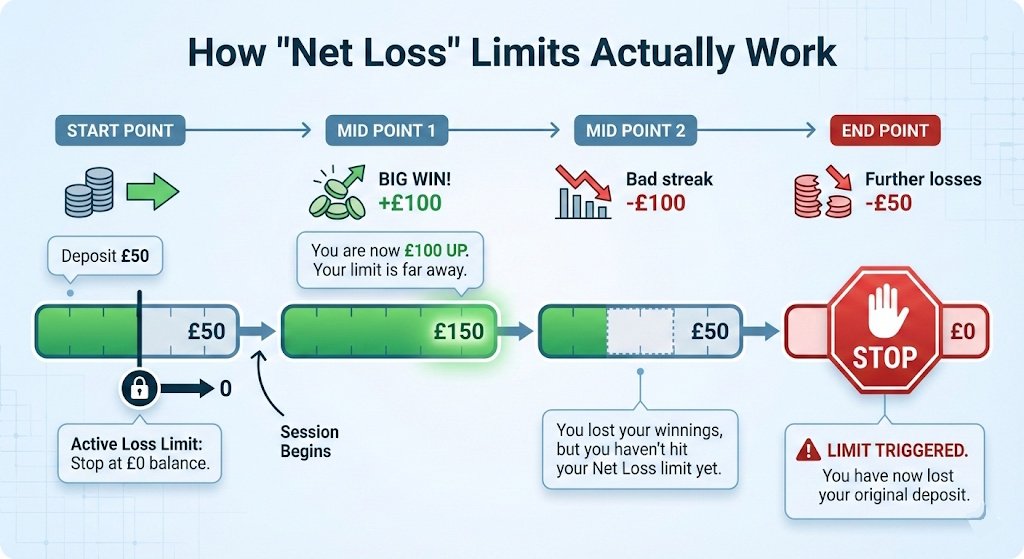
Loss Limit: This caps how much of your deposited money you can lose (e.g., stops you if your balance drops by £50). Note: Winnings often do not count towards this in the way you might expect. If you win £100 and then lose it, you haven’t technically hit a ‘net loss’ limit yet.
Wagering Limit: This limits the total amount you can bet, regardless of wins or losses. This is useful for players who want to limit their time on site rather than just their spend.
Select a Duration
You can usually set these for 24 hours, 7 days, or 30 days. For most recreational players, a monthly limit aligned with your salary date is the most logical approach.
The Cooling-Off Period
Crucially, if you try to increase your limit (make it looser), UK regulations enforce a mandatory 24-hour delay. This is your safety net to prevent rage-betting. Conversely, if you want to decrease your limit (make it stricter), the change must happen immediately.
Which Tool Is Right for You?
Not all limits serve the same purpose. Use this quick guide to match the tool to your play style.
| Limit Type | Best Used For… | Prevents… |
| Deposit Limit | Budgeting. The foundational tool for 90% of players. | Spending more than your monthly entertainment budget allows. |
| Loss Limit | Profit Protection. Best for players who want to safeguard winnings. | Giving back all your profits in a single “bad run”. |
| Wagering Limit | Volume Control. Good for high-volume slot players. | Playing for too long, even if you are breaking even. |
| Session Timer | Time Management. Essential for players who lose track of time. | Spending 4 hours playing when you only intended to play for 20 minutes. |
The Data: Why This Matters More Than You Think
You might think, “I don’t have a problem, so I don’t need a limit.” The data suggests otherwise. Even professional gamblers use limits to mitigate variance.
The ‘Head in the Sand’ Problem
Research from the University of Sydney and UK studies shows that only around 15% of online gamblers voluntarily set deposit limits. Most players believe they can self-regulate in the moment. However, the stats on ‘chasing losses’ prove this is rarely true. The illusion of control is a powerful cognitive bias that casinos rely on; limits shatter that illusion and replace it with hard boundaries.
The Power of Limits
There is a shifting tide in player behaviour. During the UK’s Safer Gambling Week 2024, there was a 14% increase in players setting deposit limits, with nearly half of them doing so for the first time. This suggests that players are becoming more educated on how to treat gambling as entertainment rather than a way to make money.
The ‘Anchoring’ Trap
Be careful how you set the limit. Studies show that when casinos offer dropdown menus (e.g., £500, £1000, £2000), players subconsciously pick higher amounts. This is called ‘Anchoring.’
The casino presents a high number as the ‘default,’ making a £500 limit seem ‘low’ by comparison, even if you can only afford £50. Always use the free-text box to type the exact figure you can afford, rather than letting the casino suggest a number for you.
Advanced Strategy: The “Pro” Approach to Limits
This distinguishes the casual player from the disciplined expert. Do not view limits as a punishment; view them as a bankroll management strategy.
The Disposable Income Formula
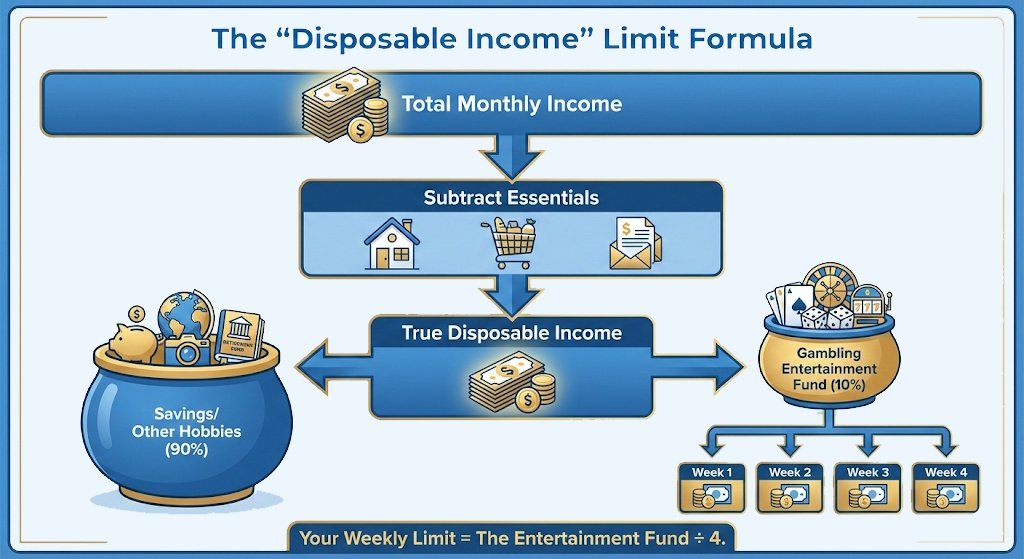
Do not just pick a random number. Use the ‘Disposable Income Formula’ to calculate a sustainable figure:
- Calculate: Determine your monthly disposable income (after bills, savings, food, and essentials).
- Allocate: Decide what percentage of that is ‘entertainment money’ (e.g., 10%).
- Divide: Divide that figure by 4. That is your weekly deposit limit.
For example, if you have £400 disposable income per month, and allocate 10% (£40) to gaming, your weekly deposit limit should be £10.
The “Belt and Braces” Approach: Bank Blocking
Relying solely on a casino’s software leaves one vulnerability: You. If you are determined enough, you might open a new account at a casino where you haven’t set a limit yet.
To close this loop, smart UK players use Bank Gambling Blocks.
- What is it? A feature offered by banks like Monzo, Starling, Barclays, and Lloyds that blocks transactions to any merchant categorised as “Gambling”.
- Why use it? It acts as a master switch. Even if you find a new casino, your card will decline the deposit.
- The Friction: To turn this block off, most banks enforce a 48-hour delay. This provides an even longer cooling-off period than the standard casino 24-hour rule, giving your “Cold State” brain ample time to regain control.
Managing Multiple Accounts
One major loophole in the limit system is holding accounts with multiple operators. If you have a £50 weekly limit but accounts at three different casinos, you actually have a £150 limit.
Pro Tip: Set your limits across all your active accounts immediately upon registration. If you struggle to manage this manually, you should consider tools that cover all operators at once. For a comprehensive overview of the market and operator reviews, visit The Casino Count.
Adjusting for Variance
If you play high-volatility slots, your bankroll will swing wildly. A tight loss limit might kick you out of a session too early before a bonus round hits. If you play low-variance games like Blackjack, your balance remains steadier. Adjust your limits based on the game type, but never exceed your financial cap. For more on game mechanics, check our How To Play Casino Game Guides.
Deep Dive: Net Loss Limits vs. Gross Loss Limits
Understanding the nuance between ‘Net’ and ‘Gross’ is critical for players using loss limits online casinos provide.
Net Loss Limits (The Standard)
Most UK casinos utilise a ‘Net Loss’ limit. This is calculated as:
- Total Deposits – Total Withdrawals/Balance = Net Position.
Example: You set a £50 loss limit. You deposit £50. You win £100 on a slot. Your balance is now £150. Because you are ‘up’, your loss limit is not active yet. You could technically lose that £100 of winnings plus your original £50 deposit before the limit kicks in. The limit only triggers when you are £50 below your starting point.
The Danger of the “House Money” Effect
This structure can be dangerous if you fall for the “House Money” effect—the belief that credit won from the casino isn’t “real” money. It is. Once it is in your balance, it is yours.
To counter this, smart players use Reality Checks (time alerts) in conjunction with loss limits. If you are up, withdraw. Do not rely solely on the loss limit to stop you losing your winnings.
Common Myths About Setting Limits
There is a lot of misinformation regarding responsible gambling tools. Let’s debunk the most common myths preventing players from using them.
Myth 1: “Setting a limit affects my luck/RTP.”
Fact: This is technically impossible. The Random Number Generator (RNG) that determines the outcome of a spin is entirely separate from the account management software that handles your limits. The game engine does not know you have a limit set; it simply produces random numbers.
Myth 2: “If I set a limit, the casino will think I’m a problem gambler.”
Fact: Quite the opposite. UKGC regulations require casinos to monitor for “markers of harm.” Erratic betting, chasing losses, and depositing at 3 AM are markers of harm. Setting a stable limit and sticking to it is a marker of sustainability. Operators prefer sustainable players who play small amounts for years over players who burn out in a week.
Myth 3: “I can just ask support to remove the limit if I change my mind.”
Fact: Customer support agents are legally bound by the 24-hour cooling-off period. No matter how much you plead, they cannot override the system. This regulation is there to protect you.
For more insights on navigating the industry, keep an eye on The Casino Count Blog.
Conclusion & Call to Action
Setting a limit takes 30 seconds, but it protects you for thousands of hours of play. It effectively ‘locks in’ your decision-making when you are calm, ensuring you never play with rent money when the heat of the moment strikes.
It is the mark of a professional. The novice thinks about how much they can win; the expert thinks about how much they can afford to lose. By defining your exit point before you even log in, you ensure that gambling remains a fun pastime rather than a financial stressor.
Your challenge today: Log into your main account right now and set a deposit limit, even if it’s just for this week. Your future self will thank you.
Stay informed and gamble safely. For more insights, contact us at info@thecasinocount.com.
Responsible Gambling Statement
Gambling is a form of entertainment, not a way to solve financial problems. The odds are always in the casino’s favour. Never bet money you cannot afford to lose. If you feel that your gambling is becoming a problem, or if you are chasing losses, stop immediately.
There are independent organisations ready to help:
- BeGambleAware.org: For confidential help and support.
- GAMSTOP: To self-exclude from all UK-regulated gambling sites for free.
Frequently Asked Questions (FAQ)
What is the difference between a deposit limit and a loss limit?
A deposit limit restricts the amount of money you can transfer from your bank into your casino account. A loss limit restricts the amount of your balance you can lose within a specific timeframe. Deposit limits are generally considered safer as they stop the money leaving your bank in the first place.
Can I remove my loss limit immediately?
No. Under UKGC regulations, any request to increase a limit or remove it completely is subject to a mandatory 24-hour cooling-off period. This allows you time to reconsider the decision away from the ‘heat’ of play. However, requests to tighten limits (lower the amount) are applied instantly.
Do loss limits apply to winnings?
Usually, no. Most loss limits at online casinos are based on ‘net loss.’ This means if you deposit £20 and win £50, you can lose that £50 profit without triggering the limit. The limit only activates when your balance drops below your specified loss threshold relative to your deposit.
Does setting a limit affect my chances of winning?
Absolutely not. The outcome of casino games is determined by a Random Number Generator (RNG). This software is audited and operates completely independently of your account settings, deposit limits, or withdrawal history.
What happens if I hit my limit in the middle of a game?
If you hit a deposit limit, you simply will not be able to add more funds until the time period resets. If you hit a loss limit, the system will usually prevent you from placing further bets. If you are in the middle of a specific spin or hand, that round will complete, but you will not be able to start a new one.





Leave a Reply