
Key Takeaways
- Understanding the psychology of gambling is essential for recognising the cognitive biases, such as the Gambler’s Fallacy, that can distort a player’s perception of probability.
- Random Number Generators (RNGs) ensure that every spin or hand is an independent event, debunking myths about “hot” or “cold” streaks.
- Recognising psychological triggers like the “near-miss” effect and the illusion of control is the first step toward maintaining a safe and responsible gaming experience.
The Psychology of Gambling
The human brain is a pattern-recognition machine, wired to find order in chaos. In most aspects of life, this is a survival mechanism; in the context of a casino, however, it can lead to expensive misconceptions. At The Casino Count, our mission is to peel back the layers of casino mechanics to reveal the mathematical reality beneath.
To be a truly informed player, one must understand not just the rules of the game, but the rules of the mind. The psychology of gambling is a complex interplay of risk assessment, reward pathways, and cognitive errors. By understanding these mental shortcuts, you can approach online gaming with objectivity and caution.
What Is the Gambler’s Fallacy?
The most prevalent cognitive bias in the gambling world is the Gambler’s Fallacy. This is the erroneous belief that if a particular event occurs more frequently than normal in the past, it is less likely to happen in the future (or vice versa).
For example, if a Roulette ball lands on Red five times in a row, the Gambler’s Fallacy suggests that Black is “due”. This feels intuitively correct, but it is mathematically false. In a fair game, the probability of Red or Black remains constant on every single spin, regardless of what happened previously.
Expert Note: The wheel has no memory. Past results do not influence future outcomes in independent events.
How Does RNG Actually Work?
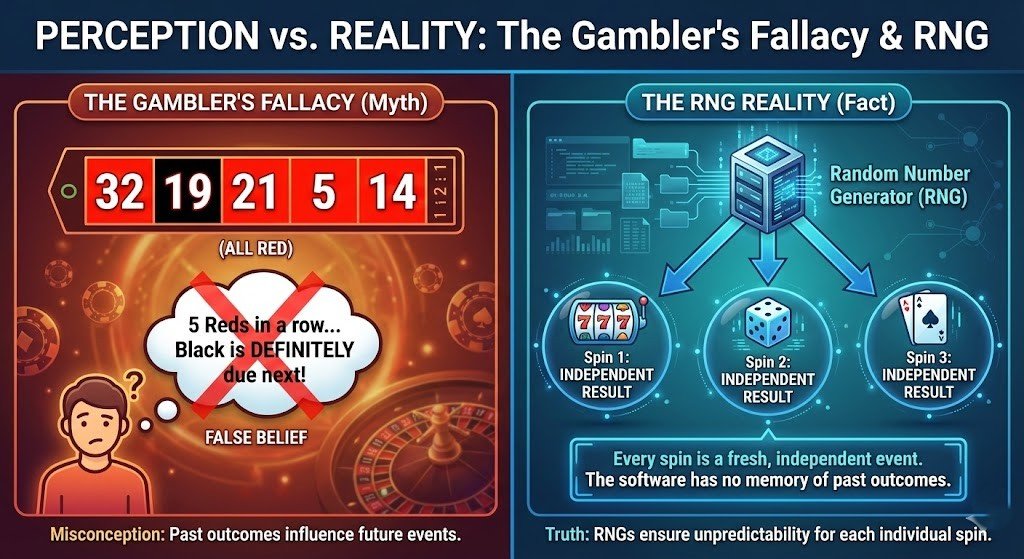
To understand why streaks are illusory, you must understand the engine behind online slots and table games: the Random Number Generator (RNG).
The RNG is a complex algorithm that generates thousands of number sequences every second, even when no one is playing. When you press “Spin”, the software grabs the most recent number sequence to determine the result.
- Independence: Every spin is an independent event.
- No Cycles: Slots do not operate on “cycles” of paying out and taking money.
- The Stats: The UK Gambling Commission (UKGC) requires that these generators undergo rigorous testing for true randomness.
This technology ensures fairness, but it also means that a slot machine is never “hot” or “cold”. Those terms are retrospective labels we apply to random variance, not predictive indicators of future performance. For more in-depth analysis on game mechanics, you can explore The Casino Count Blog.
Why Do “Near-Misses” Feel Like Wins?
Have you ever played a slot machine where two jackpot symbols line up, but the third lands just one position off? Your brain likely registered this as a “near-miss,” triggering a flush of excitement almost equal to a win.
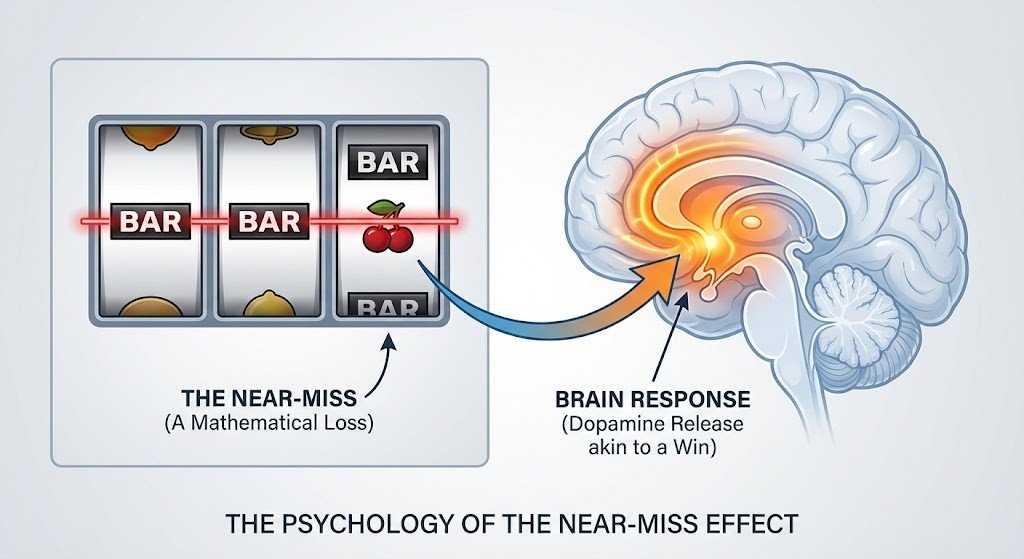
Psychological research indicates that near-misses stimulate the same reward pathways in the brain as actual victories. This can encourage players to continue playing, under the false impression that they are “getting closer” to a win.
In reality, a near-miss is mathematically identical to a total miss. The symbols on a slot reel are visual representations of the RNG’s data. Being “one spot away” is a visual design element, not an indicator that the algorithm almost selected the jackpot.
What Is the Illusion of Control?
The illusion of control occurs when players believe they can influence the outcome of a game that is largely (or entirely) defined by chance.
- Dice Control: Throwing dice harder for high numbers or softer for low numbers in Craps.
- Rituals: Wearing lucky clothing or pressing the spin button at a specific rhythm.
- Choice: Believing that picking your own lottery numbers improves your odds over a “lucky dip”.
While games such as blackjack and poker involve skill and strategy, the underlying card distribution remains random. Overestimating one’s control is a key component of the psychology of gambling that can lead to chasing losses. To understand where skill actually plays a part, we recommend reading our How To Play Casino Game Guides.
How Does “Loss Aversion” Affect Decisions?
In behavioural economics, “loss aversion” refers to the tendency for people to prefer avoiding losses to acquiring equivalent gains. Psychologically, the pain of losing £100 is often more intense than the pleasure of winning £100.
This bias can lead to the “sunk cost fallacy” or “chasing losses.” A player may continue gambling in an attempt to recoup losses, believing that they have already invested too much to quit.
This is a critical error. The money already lost is gone; it has no bearing on the probability of future hands. Recognising this emotional trigger is vital for stepping away at the right time.
Why Does the House Always Have an Edge?
It is vital to approach gambling with the knowledge that the casino holds a mathematical advantage, known as the “House Edge”.
Even in games with high Return to Player (RTP) percentages, the long-term statistics favour the operator. For instance, a slot with a 96% RTP (the industry average) is designed to return £96 for every £100 wagered over millions of spins.
This does not mean you cannot win in the short term—variance allows for wins—but the law of large numbers ensures the house remains profitable. Acknowledging this reality helps in setting realistic expectations and budgets.
The Dopamine Loop: Why We Play
Gambling triggers the release of dopamine, the brain’s “feel-good” neurotransmitter. Interestingly, dopamine levels spike not just during a win, but during the anticipation of a win.
This is known as a “variable ratio reinforcement schedule.” Because the reward (the win) is unpredictable, the brain remains highly engaged, constantly seeking the next dopamine hit. This is the same psychological mechanism behind scrolling through social media feeds.
Understanding that this is a chemical reaction, rather than intuition or luck, can help players maintain perspective.
Practical Steps for Psychological Safety
Armed with an understanding of the psychology of gambling, you can implement safeguards to protect yourself from these biases.
- Set Strict Limits: Decide on a budget before you start. Use deposit limit tools offered by operators.
- Ignore the “Due” Factor: Remind yourself constantly that previous results do not influence the next spin.
- Recognise the Myth of Control: Accept that you cannot influence the RNG.
- Take Breaks: Step away regularly to break the dopamine loop and reassess your play rationally.
For a complete breakdown of tools and strategies to keep your gaming safe, please read our comprehensive article: A Practical Guide to Responsible Gambling.
Responsible Gambling
Gambling should always be viewed as a form of entertainment, not as a means of making money. The biases discussed above can affect anyone, regardless of intelligence or experience. If you feel that gambling is stopping you from having fun or affecting your daily life, it is time to stop.
There are numerous independent organisations dedicated to supporting players:
- GamCare: Provides support and counselling for the prevention and treatment of problem gambling. Visit GamCare.
- BeGambleAware: Offers information to help people make informed decisions about their gambling. Visit BeGambleAware.
- GAMSTOP: A free service that lets you put controls in place to restrict your online gambling activities. Visit GAMSTOP.
Frequently Asked Questions (FAQ)
Can I ever overcome the House Edge?
In the long run, the mathematical House Edge cannot be overcome in games of chance such as slot machines or roulette. While short-term variance allows for wins, the statistics are built to favour the casino over millions of rounds. Strategies in skill-based games such as blackjack can reduce the edge but rarely eliminate it.
Do “hot” and “cold” slots actually exist?
No. This is a myth born from the Gambler’s Fallacy. Online slots use Random Number Generators (RNGs) that ensure every spin is independent. A slot that has just paid out a jackpot has the exact same probability of paying out again on the very next spin.
Why do I feel more confident after a few wins?
This is often due to the “hot hand fallacy.” Winning can trigger a release of dopamine and a boost in confidence, leading you to believe you are “on a roll.” It is crucial to remember that your luck does not change the mathematical probabilities of the game.
How can I stop myself from chasing losses?
The most effective method is pre-commitment. Set strict deposit and loss limits using the tools provided by the casino before you begin your session. If you find yourself emotionally compromising your limits, use blocking software like BetBlocker to enforce a break.
Stay informed and gamble safely. For more insights, contact us at info@thecasinocount.com.



Leave a Reply