

Your Essential Guide to New Player Protections
Key Takeaways
- The UK Gambler’s Bill of Rights 2026 codifies a new “Duty of Care” era, shifting the legal burden of harm prevention from the player to the operator.
- New regulations enforced in January 2026 strictly ban “mixed-product” bonuses and cap wagering requirements at 10x for many common incentives.
- Mandatory “frictionless” financial risk assessments now trigger at a £150 net deposit threshold to catch financial vulnerability early without invasive manual checks.
The UK gambling landscape has undergone its most radical transformation since 2005. As we move through 2026, the era of the “Wild West” bonus and unchecked high-stakes play has officially ended.
These changes are driven by broader market shifts, including the recent tax hikes on operators. For a honest look at how regulations are impacting player bonuses, see The Truth About Affordability Checks
The UK gambling industry currently generates a staggering £15.6 billion in Gross Gambling Yield (GGY). With 2025 data showing 48% of UK adults gamble monthly and online accounts reaching a record 37.4 million, the Gambling Commission (UKGC) has moved to ensure that growth does not come at the expense of player safety.
This “Bill of Rights” isn’t a single document, but a collection of 2025 and 2026 legislative updates that fundamentally change how you interact with online casinos. Here is everything you need to know about your rights in this new landscape.
1. UK Gambler’s Bill of Rights 2026: The Right to Fair Incentives: The End of “Predatory” Wagering
On 19 January 2026, the UKGC implemented a landmark update to the Social Responsibility Code. This update targeted the confusing and often unfair structures of casino bonuses.
Historically, players were lured with “mixed-product” offers, such as “Bet £10 on Sports to get 10 Free Spins.” This is now strictly banned unless the player has total freedom to choose where to spend the credit.
Furthermore, the “Critical Friend” perspective suggests that the 100x wagering requirements of the past were predatory. In 2026, the UKGC has moved to cap wagering requirements at 10x for many incentives, ensuring bonuses actually provide value rather than a mathematical trap.
2. The Right to Financial Sovereignty: UK Gambler’s Bill of Rights 2026
Perhaps the most debated update is the introduction of Frictionless Financial Risk Assessments. For the first time, operators must proactively check if a player can afford their level of play.
These “light-touch” checks are triggered when a player reaches a £150 net deposit within a rolling 30-day period. Unlike traditional “Source of Funds” requests, these are designed to be invisible to the user, using credit reference data to spot signs of serious financial distress.
To understand the specific open banking technology powering these automated assessments, read our deep dive on The Frictionless Check Explained.
While some critics argue this infringes on privacy, these checks are the “digital seatbelts” of modern gambling. If you are new to the scene, our How To Play Casino Game Guides can help you understand the mechanics of play before you reach these thresholds.
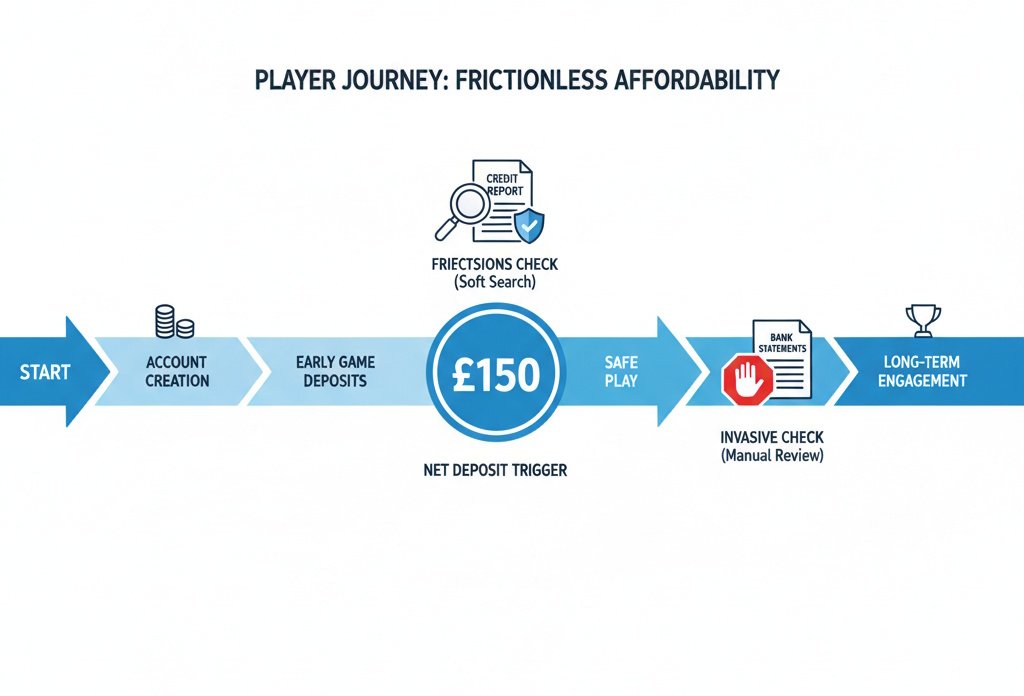
If the automated system cannot verify your financial standing, you may face a manual review. Ensure you have the correct paperwork ready by following The 2026 Source of Funds Audit Checklist.
3. UK Gambler’s Bill of Rights 2026: The Right to Transparency: Is Your Money Safe?
If a casino goes bust, what happens to your balance? Under the 2026 rules, “transparency” is no longer optional.
Operators must now clearly categorise player fund protection into three tiers:
- Not Protected: No segregation; funds are treated as part of the business assets.
- Medium Protection: Funds are segregated but not guaranteed in all insolvency scenarios.
- High Protection: Funds are held in a formal trust account, legally separate from the operator.
Since October 2025, operators offering “Not Protected” status must remind you of this every six months. Always check The Casino Count for reviews that highlight the security tier of specific operators.
4. The Right to Play Breaks & Limits: Mandatory Control
The technical standards updated on 31 October 2025 and 30 June 2026 now require mandatory deposit limit prompts. You can no longer make your first deposit without being asked to set a budget.
These limits must be “gross” deposit limits—measuring exactly what you put in, regardless of what you withdraw. This prevents the “netting” fallacy where players believe they are spending less than they actually are.
For a deeper dive into how these technical changes affect your daily play, visit The Casino Count Blog.
5. The Right to Fair Stakes: Age-Appropriate Limits
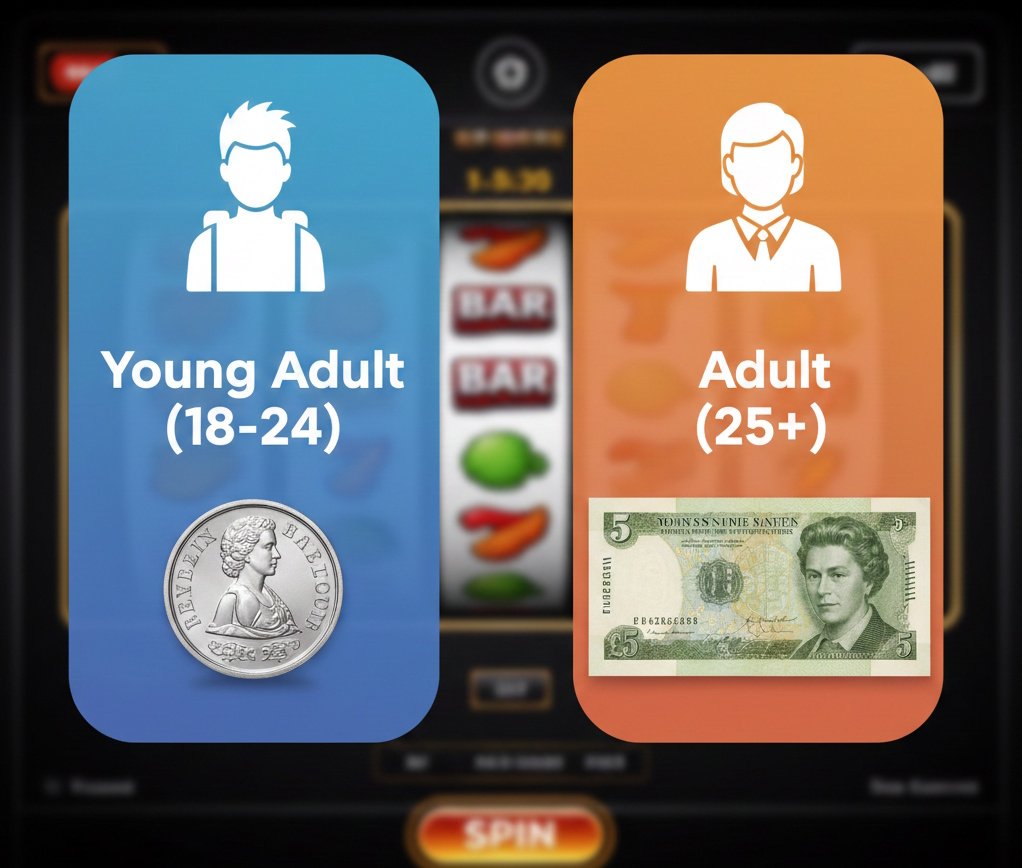
In 2026, your age determines your maximum stake on online slots. This reflects data showing that 2.5% of UK adults struggle with gambling harm, with younger demographics being particularly vulnerable.
- Under 25s: Maximum stake of £2 per spin.
- Over 25s: Maximum stake of £5 per spin.
Adapting to these caps requires a change in strategy. We have compiled a guide on volatility and gameplay tactics for younger players in Navigating the £2 Stake Limit.
This “Student Stat”,which reveals that 6 out of 10 students gamble, justifies the stricter £2 limit. It is a targeted measure to prevent life-altering losses during a period of lower disposable income.
6. The Right to Dispute Resolution: More “Bite” for Consumers
The Digital Markets, Competition and Consumers Act 2024 (DMCCA), which became fully enforceable on 6 April 2026, has replaced outdated 2015 regulations.
The Competition and Markets Authority (CMA) now has the power to fine operators up to 10% of their global turnover for unfair practices. This gives consumers significantly more leverage in disputes regarding “drip pricing” or misleading bonus terms.
If you feel an operator has breached the UK Gambler’s Bill of Rights 2026, the path to redress is now clearer and more punishing for the brand involved.
Why the Shift to a “Duty of Care” Matters
The unique angle of 2026 is the total shift in the burden of proof. Historically, the industry motto was “Gamble Responsibly,” placing the onus on the player.
The UK Gambler’s Bill of Rights 2026 marks the “Duty of Care” era. Operators are now legally responsible for predicting harm before it happens through data analysis and mandatory friction.
While some see this as a “Cautionary Tale” of over-regulation, we view the UK as the Global Gold Standard. These protections ensure that the 37.4 million active accounts can enjoy their pastime within a framework that prioritises human safety over corporate profit.
Part of this duty involves sharing data between operators to prevent harm. If you are concerned about how your personal information is handled under the new GamProtect scheme, consult our Key Event Reporting: Privacy Guide.
Responsible Gambling
Gambling should be fun. If it stops being fun, stop. If you or someone you know is struggling, there are professional resources available to help you regain control.
- BeGambleAware – Confidential support and information.
- GAMSTOP – Free national self-exclusion scheme.
- BetBlocker – Free software to block gambling sites.
- National Gambling Helpline – Call 0808 8020 133 for 24/7 support.
What is the “Mixed-Product” bonus ban?
As of January 2026, casinos cannot force you to bet on sports to earn a casino bonus (or vice versa). Each vertical must remain separate unless you are given a choice of where to use your reward.
Does a frictionless check affect my credit score?
No. These are “soft” credit checks. They are visible on your credit file but do not impact your credit score or ability to get a mortgage.
Why is my slot stake limited to £2?
If you are between 18 and 24, the UKGC mandates a £2 limit to protect younger players who are statistically at a higher risk of developing gambling-related issues.
Can I opt-out of the mandatory deposit limit prompt?
No. You must be prompted to set a limit before your first deposit. However, you can choose the amount of that limit (including choosing not to set one, though this is not recommended).
What happened to 100x wagering requirements?
Under the 2026 updates, excessive wagering requirements are considered a breach of the “fair and transparent” licensing conditions. Most reputable operators have capped these at 10x to 20x.





Leave a Reply