

Key Takeaways
- GDPR Gambling Rules: UK casinos are legally permitted to share your data without consent if it prevents “gambling-related harm” under the new GamProtect scheme. Known as Key Event Reporting.
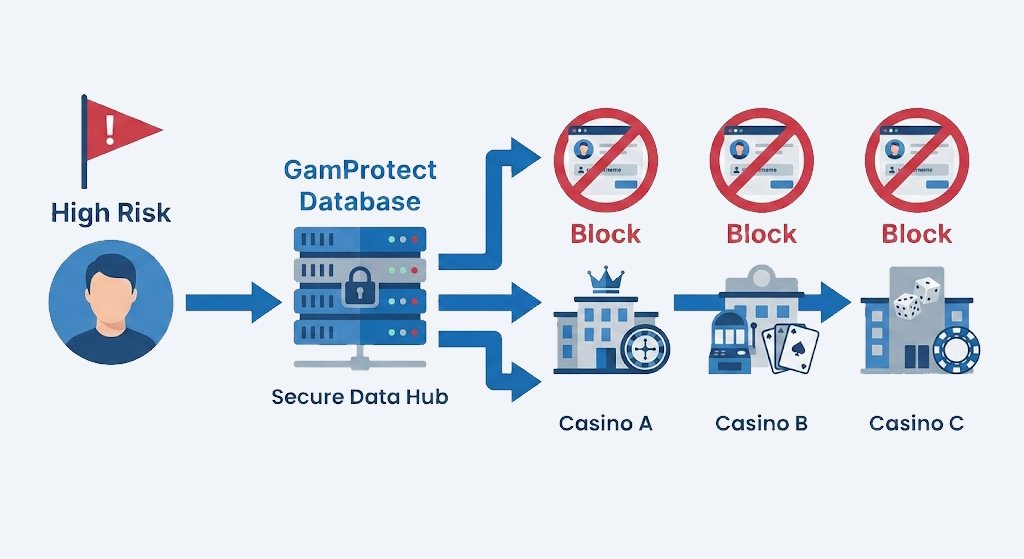
- GamProtect (Single Customer View): If one major operator flags you as “high risk” (e.g., you admit addiction), you may be automatically blocked by all other participating casinos.
- Winning vs. Safety: There is no evidence that casinos legally share data to ban “winners” collectively; data sharing is strictly ring-fenced for safety and crime prevention (AML).
In the old days of brick-and-mortar casinos, a pit boss might whisper to a colleague down the street about a card counter. Today, that whisper is a fibre-optic cable, and it travels at the speed of light.
For the modern UK player, the fear is palpable: “If I win too much at Casino A, will they tell Casino B to ban me?” Or more seriously, “Who actually sees my passport and bank details?”
With the rollout of GamProtect (formerly known as the Single Customer View) and tighter UK Gambler’s Bill of Rights mandates, the landscape of privacy has shifted. As your “Critical Friend,” I’m here to strip away the paranoia and explain exactly what data is shared, why it happens, and how it affects your wallet.
How Does “Key Event” Reporting Affect You?
In regulatory terms, a “Key Event” usually refers to an operator reporting significant incidents to the UK Gambling Commission (UKGC), such as a data breach or a change in ownership.
However, for you—the player—a “Key Event” is now something you trigger. It is a specific action or behaviour that forces a casino to generate a report and, crucially, share your data with other operators.
Under the new frameworks, you need to understand the difference between Commercial Data (your wins/losses) and Safety Data (your risk markers).
1. The GamProtect Scheme (Single Customer View)
This is the biggest shift in UK gambling privacy in a decade. GamProtect is a collaborative system used by the industry’s giants (including Entain, Flutter, and bet365).
- The Trigger: If you display “severe risk” indicators at one site—for example, you tell customer support “I have a gambling addiction” or “I cannot afford to eat because of my losses”—this is a Key Event.
- The Action: The operator does not just close your account with them. They upload your registration details (Name, DOB, Email, Phone) to the GamProtect database.
- The Consequence: Other participating operators scan this database. If they find a match, they are required to close your accounts with them too, often within 24 hours.
Critical Note: This happens without your specific consent at the moment of sharing. The Information Commissioner’s Office (ICO) has ruled that protecting life (preventing suicide or bankruptcy) overrides your right to privacy in this specific context.
2. Anti-Money Laundering (AML) & KYC
When you upload your ID to a casino, you aren’t just proving you are 18. You are entering a financial ecosystem.
Casinos are required by the UKGC to monitor for “Proceeds of Crime”. If you deposit £5,000 without a clear Source of Wealth, this is a Key Event.
- Do they share this? Generally, no—not with other casinos directly.
- Who do they share it with? They may file a Suspicious Activity Report (SAR) to the National Crime Agency (NCA) if they suspect money laundering. This is a legal requirement, not a choice.
For more on how to navigate the verification process without getting your account locked, see our guide on How To Play Casino Game Guides.
The “Blacklist” Myth: Do They Share Data to Stop Winners?
This is the most common question I get at The Casino Count. “I won big on a slot, and suddenly three other casinos limited my stakes. Are they talking?”
The Short Answer: Legally, no. The Nuanced Answer: They don’t need to talk to each other to limit you.
Why It Feels Like Collusion
- Risk Groups: Many casinos are owned by the same parent company (e.g., Flutter owns Paddy Power, Betfair, and Sky Bet). If you are “gubbed” (restricted) on one, their internal group policy allows them to restrict you on all their brands. This is not external data sharing; it is internal corporate risk management.
- The RTP Reality: Casinos rely on the Return to Player (RTP) percentage (industry average approx 96%) to make money over time. They do not need to rig games or share data to defeat you; the math does it for them.
If you are worried about unfair slot mechanics, read our deep dive on the The Casino Count Blog where we analyse variance and RNG.
Your Rights: Can You Opt Out?

Under GDPR (General Data Protection Regulation), you usually have the “Right to Erasure” (to be forgotten). However, gambling introduces a complex legal exception called “Public Task” or “Legitimate Interest.”
- Marketing Data: YES. You can opt out of all marketing data sharing. If a casino gives your email to a partner affiliate without consent, they are breaking the law.
- GamProtect/Safety Data: NO. If you have been flagged for severe gambling harm, you cannot opt out of GamProtect. The regulator views your safety as more important than your data privacy preference.
- Self-Exclusion (GAMSTOP): NO. Once you register with GAMSTOP, that data must be shared with operators to block you. You cannot demand they delete it until your exclusion period ends.
If you are struggling with control, or just want to understand the tools available, visit our responsible gambling guide.
3 Steps to Protect Your Data Privacy
While you cannot stop regulatory sharing, you can lock down your commercial privacy.
- Read the ‘Group’ Fine Print: Before signing up, check who owns the casino. If you sign up to a white-label site, you are often giving data consent to 20+ other “skins” on the same platform.
- Use Dedicated Emails: Create a specific email address solely for gambling. This limits the blast radius if a database is sold or breached.
- Formal “Right to Object”: You can formally email a casino’s Data Protection Officer (DPO) to object to data processing. While they can refuse for legal reasons (AML/Safer Gambling), it forces them to review your file manually.
Responsible Gambling Statement
Gambling is a form of entertainment, not a way to make money. The data sharing systems mentioned above (like GamProtect) exist because the risk of harm is real.
- Never chase losses.
- Set deposit limits before you play.
- If it stops being fun, stop.
For free, confidential help, visit BeGambleAware or call the National Gambling Helpline on 0808 8020 133. To block yourself from all UK sites, use GAMSTOP.
Frequently Asked Questions (FAQs)
Does GamProtect mean every casino knows my bank balance?
No. GamProtect currently shares limited registration data (Name, DOB, Email) to identify you. It does not share your bank balance, deposit history, or specific game activity with other operators.
Can I sue a casino for sharing my data with GamProtect?
It is unlikely. The Information Commissioner’s Office (ICO) has worked with the industry to ensure GamProtect complies with GDPR under the “Legitimate Interest” clause. As long as the data is accurate and used only for harm prevention, it is legal.
If I self-exclude on one site, will I be blocked on all?
If you use the operator’s internal self-exclusion, you will be blocked on that specific site and usually others in their corporate group. If you use GAMSTOP
, you will be blocked on every UK-licensed site.
I requested my data be deleted, but they refused. Why?
Casinos are required by law (Anti-Money Laundering regulations) to keep customer records for at least 5 years after the relationship ends. They cannot delete this data even if you ask, but they must keep it secure and not use it for marketing.
How do I know if I’m on a “bad player” list?
You can submit a Subject Access Request (SAR) to any casino. They are legally required to provide you with a copy of the personal data they hold on you within 30 days.





Leave a Reply