

In Great Britain, the enjoyment of placing a wager is part of a long-standing tradition. Yet, as the industry evolves—particularly with the proliferation of online platforms—the responsibility to gamble safely becomes paramount. This guide is designed as a practical manifesto for all players, outlining not just why you should play safely, but how to take active control of your experience.
Responsible gambling is not a set of rules; it is a mindset. It is the conscious decision to treat betting as a form of leisure, just like purchasing a ticket to a football match or going to the cinema. It should never be seen as a method of generating income or recouping debt.
We believe that being informed is the first line of defence in player protection. Whether you are seeking tips on managing your spend or looking for resources to help a loved one, you can find a wealth of information right here on The Casino Count.
Highlights
- Financial Firewall: The single most effective step is setting and sticking to strict deposit and loss limits before you start playing.
- Know Your Tools: UK-licensed operators are mandated to provide Reality Check alerts and Cooling-Off periods—these are your active controls.
- Self-Exclusion Power: Understand the national, multi-operator self-exclusion scheme, GAMSTOP, which provides a simple way to block access to all UK-licensed online sites.
- It’s Not Just Money: Responsible play is also about managing time and ensuring gambling never interferes with your job, family, or emotional well-being.
Take the 60-Second Safety Audit
Before you play today, run through this rapid checklist. If you answer “No” to more than one, it is time to pause.
- The “Surplus” Test: Is the money I am about to deposit 100% disposable income (i.e. not needed for rent, bills, or savings)?
- The “Time” Lock: Have I set a hard alarm on my phone for when I must log off, regardless of whether I am winning or losing?
- The “State” Check: Am I playing for fun, or am I playing because I feel stressed, bored, or need to “fix” a financial gap?
- The “Exit” Plan: Do I have a strict “Win Limit” (a profit figure at which I will immediately withdraw)?
Need a strategy to fix your answers? Read our deep dive on Bankroll Management Strategies for Casual Players.
The Cornerstone of Responsible Gambling: Setting Boundaries
The most successful gamblers are not necessarily the ones who win the most, but the ones who maintain control. This control is built on clear, non-negotiable boundaries regarding time and money.
The Cold Hard Data (2025 Statistics)
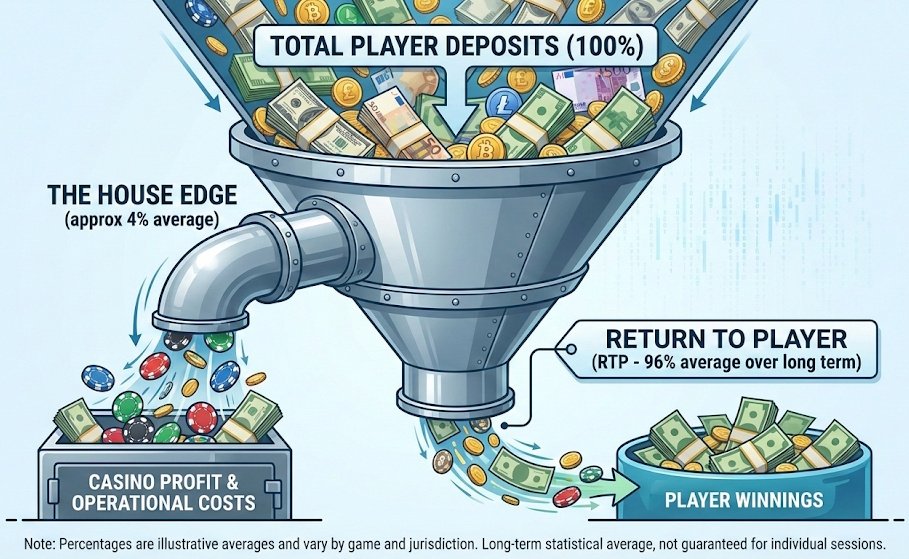
Responsible gambling is not just about feelings; it is about facts. According to the latest UKGC and industry data:
- 96% vs. 100%: The average online slot returns 96% of money wagered. The mathematical certainty is that the longer you play, the more you lose.
- The 11% Rule: Long-term tracking shows that only approx. 11-13% of players end a year in profit. If you are playing to pay a bill, the odds are overwhelmingly against you.
- 48% Participation: Nearly half of UK adults gamble, but the safest players treat it strictly as a paid expense—like a Netflix subscription—not an investment.
Know Your Numbers: Budgeting and Limits
Before you even log in, determine exactly what amount of money you can afford to lose over a set period (a week, a month) without impacting your ability to pay bills or manage essential living costs. This is your gambling budget.
Practical Steps:
- Allocate from Disposable Income: This is the bedrock and primary cornerstone of responsible gambling. It requires stringent adherence to the rule that your gambling money should come only from discretionary funds. These are specifically defined as the funds left over after all absolutely essential expenses—such as rent, mortgage payments, utility bills, necessary groceries, loan repayments, and scheduled savings contributions—are fully covered and accounted for. If you cannot lose the allocated amount and still comfortably meet all your financial obligations without worry or stress, the amount you are dedicating to gambling is definitively too much. It is a mandatory rule never to gamble with money earmarked for life’s necessities, nor should you ever attempt to gamble with money that is borrowed from any source, including friends, family, or lenders.
- Establish Strict Time-Based Budgets: Rather than simply setting one single, large budget and hoping it lasts, effective control involves breaking the expenditure down into manageable segments. You must set a firm maximum financial limit per week or per calendar month and stick to it rigidly, irrespective of whether you experience initial wins or ongoing losses. Once this predefined budget is completely spent, the gambling activity must stop immediately and entirely until the beginning of the next defined financial period.
- Use Bank Blocking Tools: In the UK, a growing number of major UK banks and financial institutions now actively offer specific, user-activated services that allow you to block all gambling-related transactions across your account. This provides a critical, extra layer of protection against highly impulsive deposits made in moments of weakness or frustration. Activating this bank-level feature creates a crucial, enforceable cooling-off period and stands as a highly effective pre-commitment tool to manage expenditure.
- Treat Winnings as Separate: A common pitfall is immediately re-wagering a profit. A core strategy is to withdraw any profit you make. This action allows you to physically separate the win from your initial, budgeted stake and powerfully reinforces the psychological idea that you possess the discipline to walk away successfully with a gain. Consider immediately depositing all winnings into a completely separate, inaccessible savings account to solidify the gain and actively prevent the dangerous and widespread ‘house money’ mentality from taking hold.
- Accept Losses as the Cost of Entertainment: It is fundamental to understand and accept that losing money is a normal, inherent, and unavoidable component of the gambling experience. The primary danger lies in the compulsion to chase losses—this behaviour is almost always the fastest and most reliable route to problematic and unsustainable gambling habits. Once your initial, set budget is completely gone, you must strenuously resist the urge to deposit more money in a desperate attempt to recoup the lost funds, a cycle which rarely ends positively. It is all part of responsible gambling and needs to be considered.
The Clock is Ticking: Managing Session Time
Gambling for extended periods can cloud judgement, leading to fatigue and impulsive decisions. Responsible gambling will involve doing a few things to ensure player safety.
Practical Steps:
- Set an Alarm: Before starting, set a physical alarm or timer on your phone. When it rings, stop. It’s a hard deadline, regardless of whether you are winning or losing.
- Plan Non-Gambling Breaks: If you plan a longer session, schedule regular 15-minute breaks every hour. Stand up, walk away from the screen, and make a cup of tea. This simple act resets your focus and helps responsible gambling become a habit.
Your Player Protection Toolkit
The UK Gambling Commission (UKGC) mandates that all licensed operators provide a suite of tools designed to help players stay in control. Familiarise yourself with them and use them proactively.
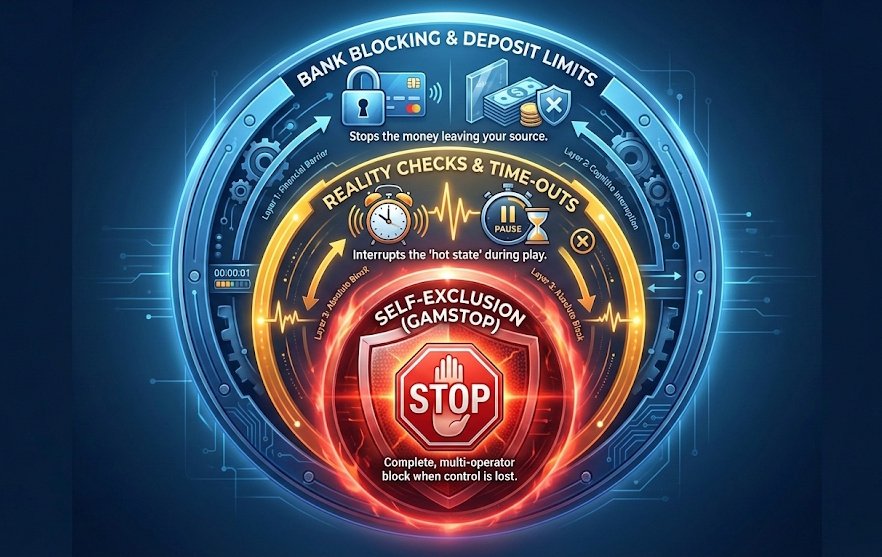
Deposit and Loss Limits: Your Financial Firewall
These are perhaps the most vital tools an operator provides for responsible gambling. They are your financial boundaries enforced by the casino itself.
- Deposit Limits: Capping the amount you can deposit over a day, week, or month. Crucially, any request to increase this limit will involve a cooling-off period (typically 24 hours) before the new, higher limit takes effect, giving you time to reconsider.
- Loss Limits: Capping the amount you can lose within a set timeframe.
Confused about the difference between a Loss Limit and a Wager Limit? We break down exactly which tool fits your playstyle in How to Set Deposit and Loss Limits
Reality Checks and Time-Outs: Taking a Breather
The UKGC requires all online casinos to implement ‘Reality Check’ alerts.
- Reality Check: A pop-up notification that appears periodically (e.g., every 30 or 60 minutes) during your play session. It displays how long you have been playing and how much you have won or lost during that session. You must acknowledge this prompt to continue playing.
- Time-Out/Short Break: If you simply need a short respite, a ‘Time-Out’ allows you to temporarily block access to your account for a short period, such as 24 hours, 48 hours, or up to six weeks.
Self-Exclusion: The Final Step (GAMSTOP & SENSE)
If you feel you are losing control or need a complete break from all online gambling, self-exclusion is the most robust measure.
- GAMSTOP: This is the national, free-to-use scheme that lets you self-exclude from all online gambling websites and apps run by companies licensed in Great Britain. Once registered, you choose an exclusion period of six months, one year, or five years, and you cannot log in or open new accounts with any participating operators during this time.
- SENSE: A similar scheme specifically for those wishing to self-exclude from land-based UK casinos.
Recognising the Warning Signs
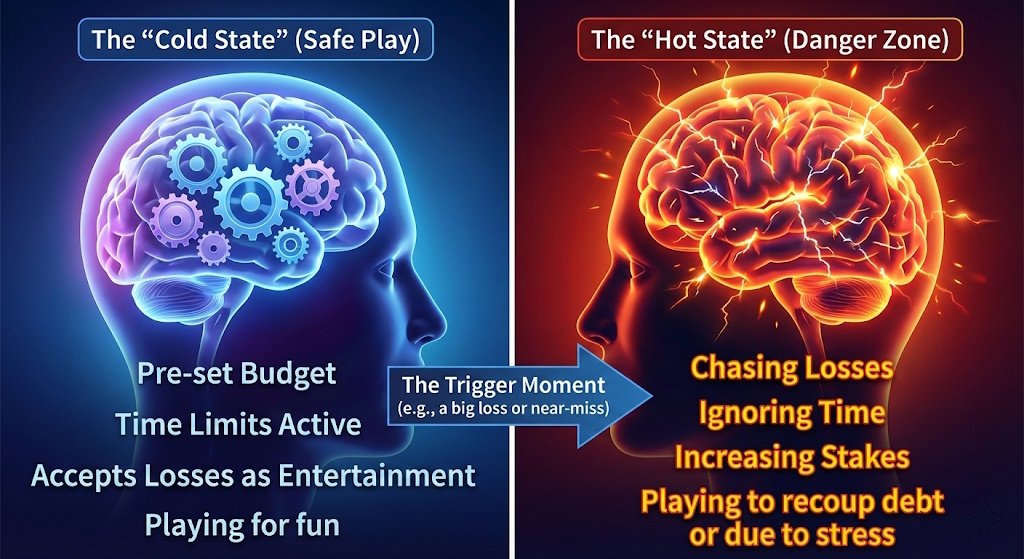
Responsible gaming extends to being self-aware and honest about your behaviour. If you are starting to use the phrase “I need to win it back,” it’s time to stop.
Identifying Changes in Behaviour
Look for these signs, either in yourself or in someone you care about:
Responsible Gambling – The Myth of Chasing Losses
This is arguably the most common and dangerous trap for any player. When you lose, the brain often defaults to a flawed logic: If I just play one more time, I can get my money back.
Fact: Every bet, every spin, and every game is an independent event with fixed odds. You are not due a win. The decision to chase a loss is an emotional one, not a logical one, and it is the fastest way to turn a manageable loss into a crisis. Accept the loss and walk away.
The Digital Detox: Stopping the “Trigger” Ads
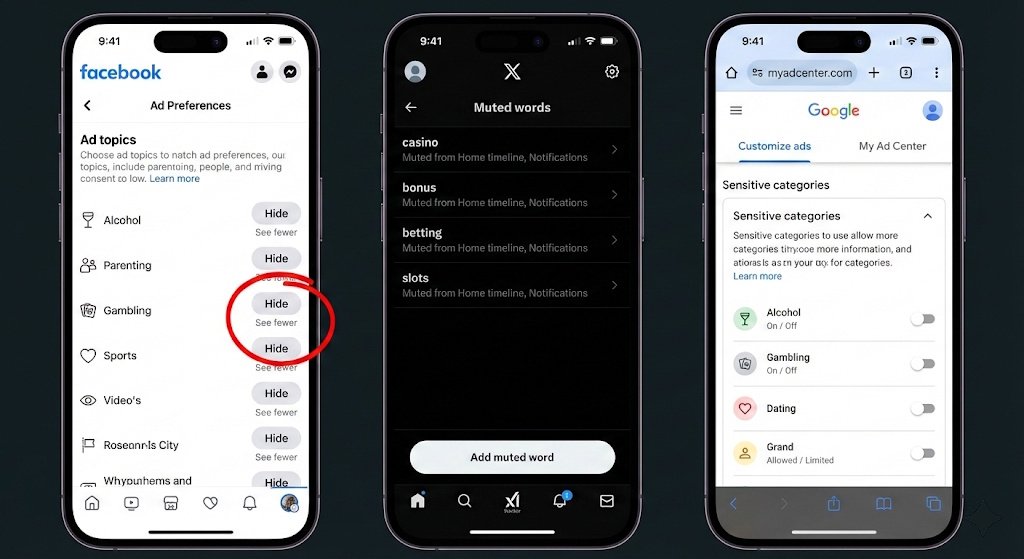
Willpower is finite; algorithms are relentless. One of the biggest unseen risks to responsible gambling is the constant bombardment of casino ads on your social media feed. Part of protecting yourself is curating your digital environment.
How to Mute Gambling Ads:
- Facebook/Instagram: Go to Settings & Privacy > Ad Preferences > Ad Topics > See Less on “Gambling”.
- X (Twitter): Go to Settings > Privacy and Safety > Content You See and mute words like “casino,” “bonus,” and “free spins.”
- Google: Go to My Ad Center and turn off gambling-related categories.
If you need stronger tools than just muting ads, check our complete guide to Free Tools and Resources for Self-Exclusion, covering software like BetBlocker and GamBan.
Where to Find Help and Support in the UK
If you or someone you know is struggling with their gambling, help is always available, confidential, and free.
The National Gambling Helpline and Support Services
Do not suffer in silence. These organisations are dedicated to providing support:
- National Gambling Helpline: Call 0808 8020 133 (Freephone, 24/7).
- GambleAware: A leading charity offering support, education, and treatment for gambling-related harm.
- GamCare: Provides support and information for anyone affected by problem gambling.
The Role of the Regulator: The UKGC
All reputable operators mentioned on this site and across the industry must hold a licence from the UK Gambling Commission. The UKGC’s objectives are straightforward:
- Keeping crime out of gambling.
- Ensuring gambling is conducted in a fair and open way.
- Protecting children and other vulnerable persons from being harmed or exploited by gambling.
This regulatory framework is the backbone of player protection in the UK.
Conclusion: A Commitment to Control
Responsible gambling is a partnership between you, the player, and the operators and regulators who enforce the rules. Your role is the most important: you must commit to using the tools and honouring the limits you set.
We will be delving into specifics in the future, Be sure to check back on for the next posts in this essential series. Play safe, stay in control, and keep it enjoyable. Looking for more gambling information, The Casino Count Blog has lots of great posts to explore.
Does self-exclusion (GAMSTOP) affect my credit rating?
No. Registering with GAMSTOP or using tools like BetBlocker does not appear on your credit file. It will not affect your ability to get a mortgage or a loan. It is a private arrangement between you and the gambling operators.
Can I reverse a deposit limit if I change my mind?
Not immediately. Under UK regulations, requests to increase your deposit limit (allow you to spend more) are subject to a mandatory 24-hour cooling-off period. However, requests to decrease your limit (tighten your control) are applied instantly.
What is the “safest” amount to bet?
A common rule of thumb for bankroll management is the 1% Rule. Never bet more than 1% of your total disposable gambling budget on a single spin or hand. If you have £50 to play with, your spins should be no more than 50p.
How do I know if I’m chasing losses?
Chasing losses is the urgent feeling that you must continue playing to “win back” money you have just lost. If you find yourself depositing again immediately after a loss, or betting higher stakes to recoup a deficit, you are chasing. See our guide on Recognising the Signs of Problem Gambling for more indicators.





Leave a Reply