
Key Takeaways:
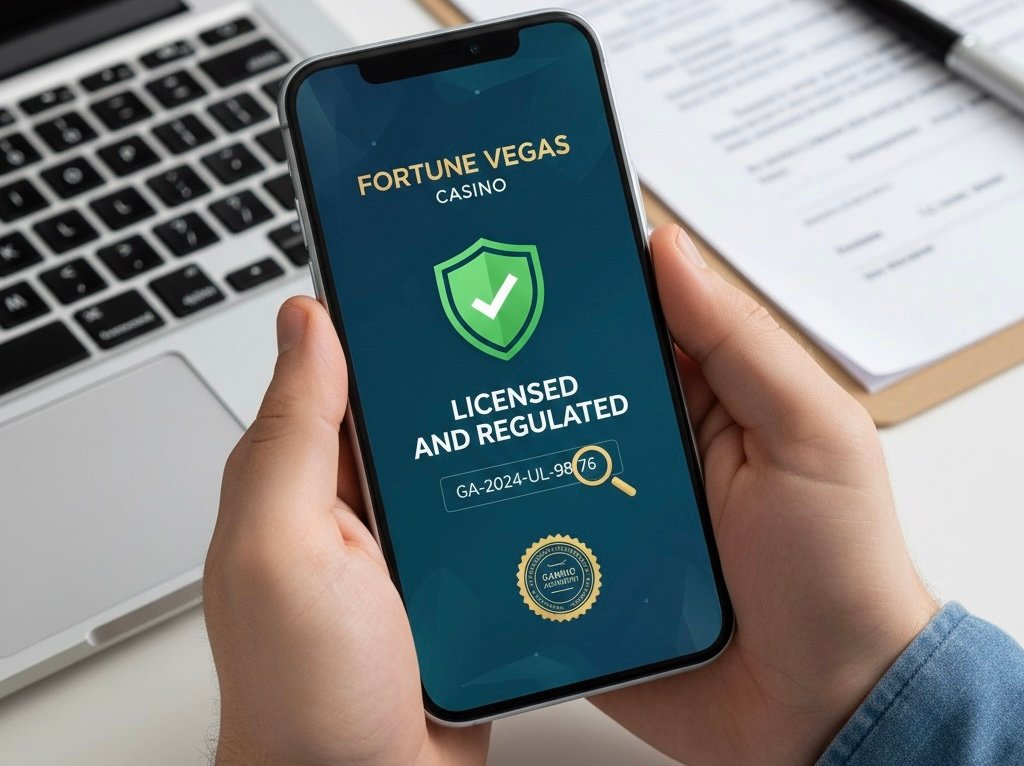
- Verify direct from the source: Never rely solely on the logo in a casino’s footer; always click through to the regulator’s official public register (e.g., the UK Gambling Commission website) to confirm the license status is ‘Active’.
- Check the domain URL: Scammers often clone legitimate sites. Ensure the URL listed on the regulator’s license matches the exact URL of the casino you are visiting.
- Understand the jurisdiction: For UK players, only a UK Gambling Commission (UKGC) license offers legal protection. Offshore licenses, such as those in Curacao or the MGA, do not provide the same level of recourse for British residents.
Verify Casino License: Introduction
In the digital age of gambling, the barrier to entry for launching an online casino has lowered, leading to a surge in both high-quality platforms and illicit operators. For a player, the distinction between a legitimate, regulated site and a fraudulent one is not always immediately obvious. Glossy graphics and generous bonuses can easily mask a site that operates without oversight.
Knowing how to verify an online casino’s license is the single most effective skill you can possess to protect your bankroll and personal data. It is not merely about compliance; it is about ensuring that when you win, you are actually paid. In this guide, we will walk you through the exact steps to verify licenses from the world’s major regulators, analyse the risks of unregulated play, and provide you with unique data on recent regulatory crackdowns that highlight why this due diligence is essential.
Verifying a licence is the non-negotiable first step in due diligence, yet a valid licence is only the foundation of a secure experience. A top-tier operator builds upon this regulatory compliance with transparent RTP reports and certified data encryption. To understand how to evaluate these additional safety layers beyond the licence number, please consult our master guide: Your Guide to Fair & Safe Online Gambling.
The 5-Second Sanity Check (Mobile Quick Guide)
In a rush? You don’t always need a magnifying glass to spot a fake. Use this rapid checklist to vet a casino in under five seconds:
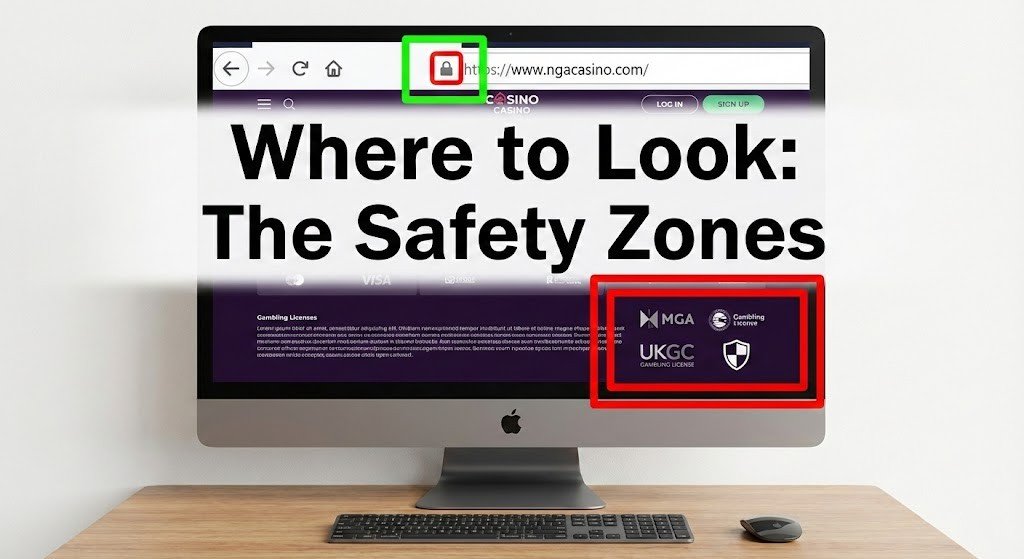
- Scroll to the Footer: Does the casino display a regulatory logo (UKGC, MGA, or Curacao)?
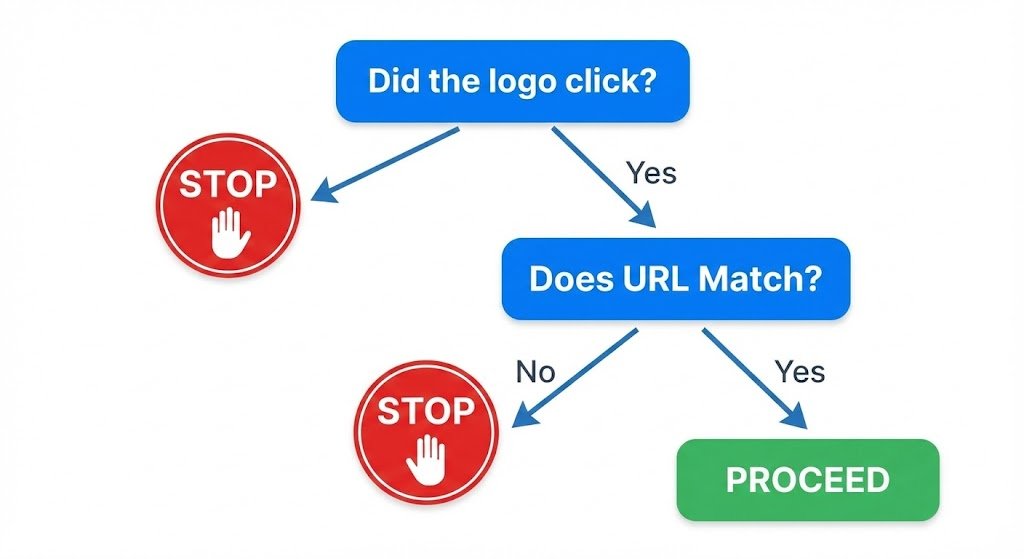
- The “Click” Test: Tap the logo. If it is just a static image that doesn’t open a new tab, leave immediately. Legitimate logos always link to the official register.
- URL Glance: When the official register opens, look at the address bar. Does the website listed on the license match the website you are playing on? (e.g.,
bet365.comvsbet365-wins.com). - The Padlock: Ensure the browser address bar shows a padlock icon (HTTPS). Never deposit on a site marked “Not Secure”.
Pass all four? You are likely safe. Read on for the deep-dive verification steps.
Why Is Checking a Casino License Critical?
Before we dive into the how, it is vital to understand the why. A license is not just a piece of digital paper; it is a legally binding agreement between the operator and a regulatory body. This agreement forces the casino to adhere to strict standards regarding player funds, game fairness, and anti-money laundering (AML) protocols.
Without a valid license, a casino is essentially a black box. There is no government oversight to ensure the Random Number Generator (RNG) is truly random, and there is no legal requirement for them to segregate player funds from operational accounts. If an unlicensed casino goes bankrupt, your money disappears with it. If they refuse to pay out a jackpot, you have no legal recourse.
Furthermore, verifying a license is your primary defence against identity theft. Regulated casinos must comply with the GDPR and other relevant data protection laws. Unlicensed sites often sell player data to third parties, resulting in a surge of spam and potential financial fraud.
Which Licensing Bodies Actually Matter for UK Players?
Not all licenses are created equal. In the world of iGaming, jurisdictions are categorised based on the stringency of their regulations and the level of protection they offer to players.
The Gold Standard: UK Gambling Commission (UKGC)
For any player physically located in the United Kingdom, this is the only license that holds legal significance. The UKGC is widely regarded as the strictest regulator globally. They enforce robust affordability checks, strict advertising standards, and mandatory participation in schemes like GAMSTOP. If a casino accepts UK players but does not hold a UKGC license, it is operating illegally.
The European Standard: Malta Gaming Authority (MGA)
The MGA is a heavyweight in the European market. While an MGA license does not legally authorise a casino to operate in the UK, it is a strong sign of legitimacy for international casinos. Many reputable brands hold both UKGC and MGA licenses, covering different jurisdictions.
The Offshore Hubs: Curacao, Gibraltar, and Alderney
Curacao is a popular jurisdiction for startups due to lower taxes and easier setup processes. However, historical oversight has been looser compared to the UKGC. It is worth noting that significant changes occurred in late 2024 with the introduction of the National Ordinance on Games of Chance (LOK), aiming to tighten these standards. Gibraltar and Alderney (and the Isle of Man) are reputable, often hosting established British bookmakers, but again, the UKGC license is the requirement for UK operations.
2025 Regulatory Update: The Landscape Has Changed
If you have been gambling for years, you might rely on old habits to spot safe sites. However, 2025 has introduced major changes to how licenses work.
The Curacao “Clean-Up” (LOK Regime)
For years, Curacao licenses were seen as “loose” due to a system of Master Licenses and sub-licenses. As of December 2024, the new National Ordinance on Games of Chance (LOK) came into effect.
- What changed: The Curacao Gaming Control Board (GCB) now issues licenses directly. The confusing web of “Master Licenses” (like Antillephone N.V.) is being phased out.
- What to look for: You may now see a new Digital Seal issued directly by the GCB. During the 2025 transition period, older seals are still valid, but a direct GCB seal is the new gold standard for crypto-friendly casinos.
UKGC Financial Risk Checks
You might notice UK casinos asking for more documents than before. This is not a scam; it is a safety measure.
- The £150 Threshold: From February 2025, the UKGC requires operators to conduct “light-touch” financial vulnerability checks if you deposit a net £150 in a rolling 30-day period.
- What this means: If a casino asks for proof of funds, verify their license first. If they are UKGC verified, comply—they are legally required to ask to protect you. If an unlicensed site asks for this, do not provide it.
How Do I Verify a UK Gambling Commission (UKGC) License?
Verifying a UKGC license is a straightforward process that should take less than two minutes to complete. Do not skip this step if you are depositing money from the UK.
How Do I Verify a UK Gambling Commission (UKGC) License?
Step 1: Locate the License Information
Scroll to the very bottom of the casino’s homepage. By law, UK-licensed operators are required to display the UK Gambling Commission logo and their 5-digit account number.
Step 2: Click the Logo
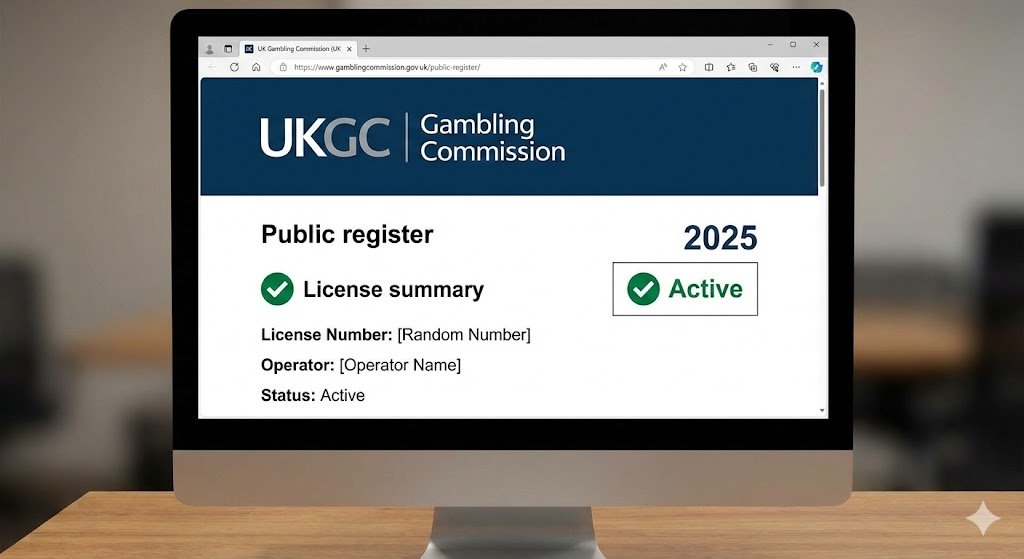
In a legitimate casino, the UKGC logo will be a hyperlink. Clicking it should take you directly to the Public Register page on the gamblingcommission.gov.uk domain.
Red Flag: If the logo is just a static image and does not click through, be suspicious.
Step 3: Check the License Status
On the Public Register page, look for the status of the license. It should clearly say “Active”.
Note: You might see statuses like “Suspended” or “Surrendered”. If you see these, do not deposit.
Step 4: Verify the Domain Name
This is the step most players miss. On the UKGC register page, look at the list of “Domain Names”. Ensure the URL of the casino you are on matches one of the domains listed on the register exactly.
Scam Tactic: Fraudsters create clone sites like bet365-bonus-win.com. The real license is for bet365.com. If the domain in your address bar is not on the register, you are on a fake site.
How Can I Check a Malta Gaming Authority (MGA) License?
If you are an expat or travelling, you might encounter MGA casinos. The verification process is similar but has its own specific register.
- Find the MGA Dynamic Seal: Look for the MGA logo in the footer.
- Verify on the MGA Portal: Clicking the logo should lead you to the MGA’s Licensee Register.
- Check the URL: Ensure you are on authorisation.mga.org.mt or the main mga.org.mt website. Phishing sites often fake this page.
- Confirm Approved Games: The MGA license also lists approved game providers (verticals). If the casino offers games from a provider not listed on their license, they may be using pirated software.
What Are the Steps to Verify a Curacao eGaming License?
Curacao licensing is complex because there is a system of Master License holders and sub-licenses. However, as of December 2024, the new National Ordinance on Games of Chance (LOK) has come into effect, streamlining this process.
To verify:
- Identify the Master Licensee: Look for logos from one of the four traditional Master License holders (e.g., Antillephone N.V., Curacao eGaming).
- Click the Validator Seal: This should open a pop-up or new tab hosted by the licensor (e.g., validator.antillephone.com).
- Check the Status: The status should read “Verified” or “Valid” in green.
- Watch for “Unverified”: If the validator page shows an error or “Unverified,” the casino is operating without a valid sub-license.
What Are the Warning Signs of a Fake License?
Scammers are becoming increasingly sophisticated. They will often copy the footer code of a legitimate site, including the license logos, and paste it onto their fraudulent platform.
Here are the key indicators that a license is fake:
- Non-Clickable Logos: As mentioned, license logos must link to the regulator. If it’s just a JPEG, it’s likely fake.
- Wrong Redirects: The link takes you to the regulator’s homepage rather than the specific license record for that company.
- Mismatched Company Names: The license is valid, but it belongs to “Ocean Star Limited” and the casino footer says it is operated by “Galaxy Bets NV”.
- Broken English/Typos: Regulatory statements are legal texts. If the footer says “Licensed by the UK Gambling Commission” (note the typos), it is a scam.
Anatomy of a “Clone” Casino
A “Clone” is a fake site designed to look exactly like a famous brand (e.g., LeoVegas or 888) to steal your login details. While checking the license is the ultimate proof, clones often have specific visual “tells”:
- The “Pixelated Logo” Syndrome: legitimate casinos have high-definition assets. Scammers often scrape images, resulting in blurry or pixelated logos, especially in the footer.
- Broken Links: Try clicking the “Terms and Conditions” or “Responsible Gambling” links in the footer. On clone sites, these often lead nowhere (404 error) or just reload the homepage.
- Old Copyright Dates: A legitimate casino updates its footer automatically. If you see “Copyright © 2021” at the bottom of a page in 2025, treat it with extreme caution.
- Limited Payment Options: Real UK casinos offer Visa, Mastercard, PayPal, and Trustly. If a “UK” site only offers Crypto or obscure voucher payments, it is likely a clone or an unregulated offshore site.
How Does Licensing Affect Game Fairness and RTP?
A license does not just cover the money; it covers the mathematics. Licensed casinos are required to have their software audited by independent testing agencies, such as eCOGRA, iTech Labs, or GLI.
These audits verify the Return to Player (RTP) percentages. For example, if a slot advertises a 96% RTP, the audit ensures that over millions of spins, it actually returns 96%.
- Regulated: The game runs from the official server of the provider (e.g., NetEnt, Playtech). The casino cannot alter the outcome.
- Unregulated: Unlicensed casinos often use “pirated” versions of popular slots. These look identical but are hosted on private servers where the casino can lower the RTP to 20% or less, making it mathematically impossible to win in the long run.
Recent Regulatory Actions: Who Got Fined in 2025?
To illustrate that regulators do bite, we can look at recent enforcement actions. This data proves that even big names are watched closely, and it highlights the protection you lose when leaving the regulated market.
In 2025 alone, the UKGC has issued significant fines, demonstrating their active monitoring:
- Platinum Gaming Limited: Fined £10 million in late 2025 for social responsibility and AML failures.
- NetBet Enterprises: Ordered to pay £650,000 for regulatory failures in November 2025.
- ProgressPlay Limited: Fined £1 million in August 2025.
These fines often stem from casinos failing to protect vulnerable players or failing to ask for the source of funds. While these checks can be annoying for players, they are a sign that the system is working to prevent crime and harm. Unregulated casinos will never ask for your source of funds, but they may also never process your withdrawal.
Unique Data: The Risks of the Unregulated Market
While the allure of “no KYC” (Know Your Customer) casinos is strong, the statistics on the unregulated market are sobering.
- Fraud Risk: Industry reports suggest that over 90% of player disputes in unregulated markets (where the player is not paid) go unresolved because there is no ombudsman to intervene.
- Global Impact: In markets with loose regulation, such as South Africa, illegal offshore operators account for an estimated 62% of all online gambling activity. This massive shadow market puts millions of players at risk of losing their entire funds.
- Problem Gambling: Statistics indicate that players on unregulated sites are significantly more likely to develop gambling harms. Without tools like GAMSTOP or deposit limits, players have no safety net in place.
What Should I Do If a Casino Has No License?
If you discover a casino has no license, or a fake one:
- Do Not Deposit: Under no circumstances should you transfer funds.
- Withdraw Immediately: If you already have funds there, attempt to withdraw them immediately. Do not play “one last hand”.
- Report It: You can report the site to the UKGC or non-profit watchdogs like The Casino Count to help warn other players.
- Check Your Bank: If you deposited via card, keep an eye on your statement. You may want to request a new card number if you suspect the site was a phishing front.
Frequently Asked Questions (FAQ)
Is a Curacao license legal in the UK?
Technically, no. A Curacao license allows a casino to operate globally, but it does not give them the legal right to advertise to or accept players from the United Kingdom. UK residents should strictly stick to UKGC-licensed sites for legal protection.
What should I do if a casino has no license at all?
Stop playing immediately. Request a withdrawal of any remaining funds (though this may be difficult). If you deposited via credit card, contact your bank to discuss a potential chargeback due to fraud, as operating without a license is illegal in many jurisdictions.
Can I trust a casino just because it has a license logo?
No. A logo is just an image file; anyone can put one on a website. You must click the logo to ensure it redirects to the regulator’s official validator page. If it doesn’t click, or if it takes you to the regulator’s homepage instead of a specific license page, it is likely fake.
What is the difference between “Active” and “Sanctioned” status?
Active: The casino is fully compliant and safe to play.
Sanctioned/Suspended: The casino is under investigation for breaking rules (e.g., failing to pay winners or weak anti-money laundering checks). Avoid these sites until the status returns to Active.
Why do I need to verify the domain name on the license?
Scammers create “clone” sites with URLs that look similar to the real one (e.g., bet-365.co instead of bet365.com). The license register will list the exact authorised domains. If the URL in your browser bar doesn’t match the list perfectly, you are on a fake site.
Conclusion
Verifying an online casino’s license is the digital equivalent of checking a car’s history before you buy it. It takes moments, but it saves you from potential financial disaster. By sticking to UKGC-regulated sites, you ensure that your games are fair, your data is secure, and your winnings are legally payable.
At The Casino Count, we only review and recommend casinos that have passed these rigorous licensing checks. Do not leave your safety to chance; always verify before you verify your account.
For more guides on safe gambling, visit our blog at The Casino Count Blog. If you have concerns about a specific casino or want to report a suspicious operator, contact us at info@thecasinocount.com.
Responsible Gambling Statement
Gambling should always be a form of entertainment, never a way to make money. The safety mechanisms discussed in this article, such as licenses and regulations, are in place to protect you, but personal responsibility is also paramount.
If you or someone you know is struggling with gambling, help is available.
• BeGambleAware: https://www.begambleaware.org
• National Gambling Helpline: 0808 8020 133 (Free, 24/7)
• GAMSTOP: Register to self-exclude from all UK licensed gambling websites for free.
Disclaimer: The information provided in this article is for educational purposes and does not constitute legal advice. Regulatory status can change; always verify the information on the official regulator’s website.





Leave a Reply