

Key Takeaways
- Effective bankroll management treats gambling funds strictly as an entertainment expense, similar to a concert ticket, rather than an investment.
- Utilising the “Unit System” safeguards your funds by ensuring you never wager more than 1–3% of your total budget on a single bet.
- Setting strict stop-loss limits and realistic win caps is the only mathematical defence against the inevitable house edge and variance.
Bankroll Calculator
| Your Monthly Budget | Safe Slot Bet (1%) | Safe Table Bet (3%) | Max “Aggressive” Bet (5%) |
| £50 | £0.50 | £1.50 | £2.50 |
| £100 | £1.00 | £3.00 | £5.00 |
| £200 | £2.00 | £6.00 | £10.00 |
| £500 | £5.00 | £15.00 | £25.00 |
Use this quick reference guide to find your safe betting limit instantly.
Why Is Bankroll Management Critical for Casual Players?
We have all been there. You deposit £20 into an online casino, intending to play for an hour. Ten minutes later, a bad run of luck hits, the balance reads £0.00, and you feel that nagging urge to deposit “just another £20” to win it back.
This is the classic trap of the casual player.
The difference between a frantic gambler and a disciplined player isn’t luck; it is bankroll management. At The Casino Count, we define a bankroll not as money you hope to double, but as an “entertainment budget.” Think of it exactly like the cost of a ticket to a football match or a night out at the pub.
Once the money is spent, the entertainment is over. Proper management does not guarantee you will win a jackpot. However, it guarantees you won’t go broke in the first hour and helps keep gambling a fun, sustainable activity.
What Does the Data Say About Winning and Losing?
To manage your money effectively, you must first dispel the illusion of “easy wins.” The gambling industry is built on mathematics, not magic, and the data paints a very clear picture of the reality facing players.
What Is the 11% Rule?
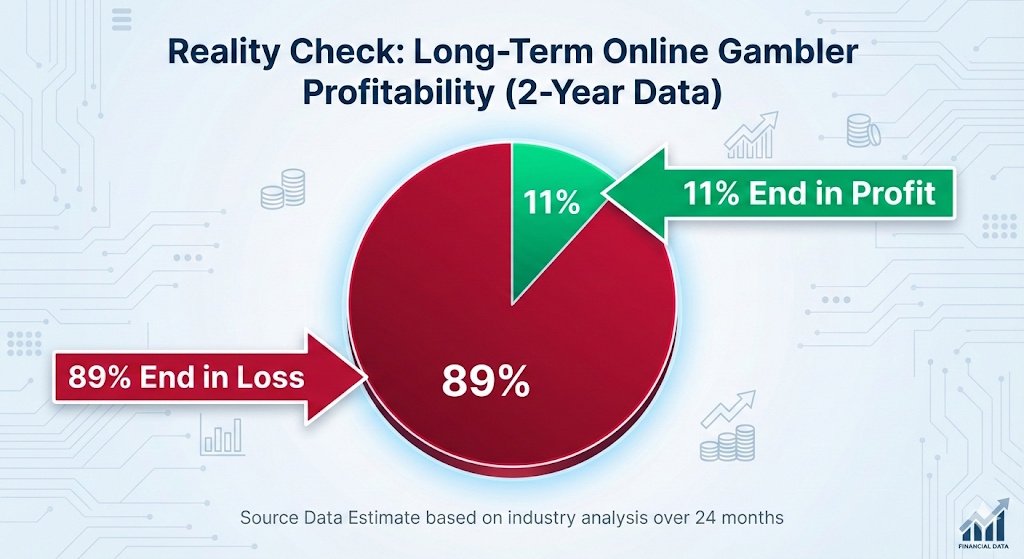
Analysis of online gambling data over two-year periods suggests a sobering statistic. Only approximately 11–13% of online gamblers actually end up in profit over the long term.
This means that nearly 90% of players will lose money over an extended timeframe. If you enter the casino expecting to be in that top 11% without a plan, you are statistically setting yourself up for disappointment.
Does Playing More Mean Winning More?
There is a common myth that “heavy” gamblers eventually win it all back. Data on player volume debunks this entirely. The top 10% of heaviest gamblers (by betting volume) consistently lose the most money.
Volume acts as a multiplier for the house edge. The more you play, the more opportunities the casino has to let the mathematics work in their favour. Therefore, a solid betting strategy isn’t about playing more; it is about playing smarter to preserve your funds.
How Should You Separate Your Gambling Funds?
The first tactical step in money management is the complete separation of funds. You should never, under any circumstances, bet directly out of your main current account where your rent, bills, and grocery money live.
The “Pot” Method
Creating a dedicated “Pot” or a separate e-wallet specifically for your gambling budget is essential bankroll management. Let’s look at a practical example.
If your monthly disposable income (after all bills and savings) is £2,000, and you decide to allocate £50 for betting, that £50 is your total bankroll. Transfer it to a separate account (like PayPal, Skrill, or a secondary debit account).
Once that £50 is gone, it is gone until the next month. This physical separation adds a layer of friction that prevents impulsive re-depositing. For more insights on managing your play, you can explore The Casino Count Blog for regular updates.
The “Bonus Buffer” Strategy: Stretching Your Deposit
Smart casual players use casino bonuses not just for extra chances to win, but as a defensive “buffer” for their own cash. If a casino offers a 100% match bonus, you are effectively halving the cost of every spin or hand you play (wagering requirements notwithstanding).
How to apply a bonus buffer for your bankroll management.
Calculate the Real Cost
If you deposit £50 and get a £50 bonus, you have £100 to play with. A £1 spin now effectively only costs you 50p.
Maintain Your Unit Size
Do not increase your bets just because your balance looks bigger. Stick to the unit size calculated on your cash deposit (£50), not the total (£100).
The Result
You have effectively doubled the number of game rounds you can play, significantly reducing the risk of ruining your bankroll early in the session.
Note: Always check the wagering requirements. High wagering requirements (e.g., 50x) can make it difficult to withdraw winnings, but for a casual player seeking longer playtime, the bonus buffer is invaluable.
What Is the “Unit” System and How Does It Work?
Professional gamblers and poker players do not think in terms of pounds; they think in terms of “Units.” This is a method used to standardise betting and protect your balance from rapid depletion.
The Golden Rule of Units
The mathematical golden rule of bankroll management for gamblers is to never bet more than 1–3% of your total bankroll on a single wager. This percentage is your “Unit.”
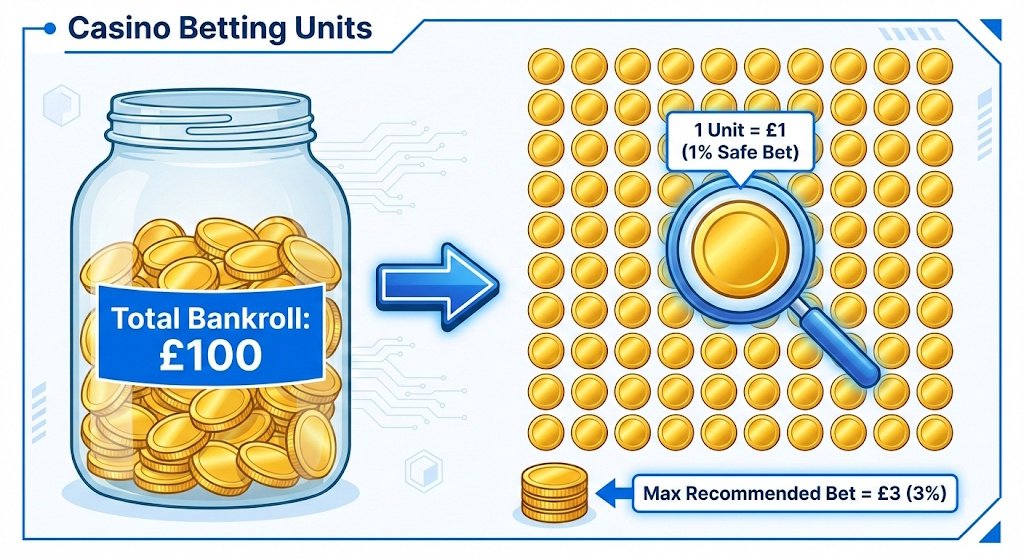
Casual Example:
- Total Bankroll: £100
- 1 Unit (1%): £1
- Max Bet (3%): £3
Why Is This Necessary?
This system allows you to absorb a losing streak. Losing 10 to 20 bets in a row is statistically common in high-variance games like slots. If you are betting £10 spins on a £100 budget, ten losses wipe you out instantly.
If you are betting £1 spins, a ten-spin losing streak only costs you 10% of your bankroll, leaving you with plenty of ammunition to continue playing.
Conservative vs. Aggressive Approaches
- Conservative (1%): Best for longevity. If you want your £100 to last the whole weekend, stick to £1 bets.
- Casual/Aggressive (3-5%): Acceptable for short-term fun, but understand that your “Risk of Ruin” (the statistical probability of losing everything) is significantly higher.
How Do Variance and RTP Affect Your Budget?
Many casual players blame “bad luck” when they lose, but they are often fighting against Variance and Return to Player (RTP). Understanding these concepts is vital before you even load a game.
What Is RTP?
RTP stands for Return to Player. It is the percentage of all wagered money that a slot or game pays back to players over time. The industry average for online slots is roughly 96%.
This means for every £100 wagered, the mathematical design of the game dictates that the casino keeps £4, and £96 is returned to players as winnings. However, this is calculated over millions of spins. In the short term, anything can happen.
Bankroll management is your only shield against this 4% house edge. It ensures you can play long enough to potentially hit a bonus round or a win that puts you above the statistical average.
What Is Variance?
Variance (or volatility) refers to the risk level of a game.
- High Variance: Infrequent wins, but the payouts are larger. These games can destroy a small bankroll quickly.
- Low Variance: Frequent small wins. These extend your playtime but rarely result in massive jackpots.
If you have a small budget, stick to low-variance games to maximise your entertainment time. To understand the specific variance of different games, we recommend reading our How To Play Casino Game Guides.
Bankroll Blueprints: Adjusting Your Strategy by Game Type
One size does not fit all in the casino. A £100 bankroll behaves very differently on a slot machine compared to a Blackjack table. To play smarter, you should adjust your unit size based on the speed and volatility of the game you choose.
The Slot Machine Strategy (High Volatility)
- The Risk: Slots are fast. You can spin 10-15 times a minute, meaning a standard 3% unit could deplete your budget in under 15 minutes of bad luck.
- The Adjustment: Lower your unit size to 0.5% – 1% of your total bankroll.
- Practical Example: With a £100 budget, stick to 50p or £1 spins. This “cushion” allows you to weather the dry spells typical of high-variance games while waiting for a bonus round.
The Table Game Strategy (Low Volatility)
- The Risk: Games like Blackjack or Baccarat (when played with basic strategy) have a lower house edge and slower pace than slots.
- The Adjustment: You can safely increase your unit size to 3% – 5% of your bankroll.
- Practical Example: With a £100 budget, £3 to £5 hands are sustainable because the “swing” (variance) is less violent. You are likely to win nearly as many hands as you lose in the short term.
The Roulette Strategy (Mixed Volatility)
- The Adjustment: This depends on your bet type.
- Even-Money Bets (Red/Black): Treat this like a Table Game (3-5% units).
- Straight-Up Bets (Single Numbers): Treat this like a Slot Machine (0.5% – 1% units) due to the low frequency of wins.
The Professional’s Secret: Tracking Your Play
You don’t need complex spreadsheets to track your play, but you do need to know if you are winning or losing over time. Memory is deceptive; most players remember their big wins and forget their slow bleeds.
The “Session Log” Method Keep a simple note on your phone with three columns: Date, Buy-in, and Cash-out.
- 01/01: In £50 | Out £0 (-£50)
- 08/01: In £50 | Out £85 (+£35)
- 15/01: In £50 | Out £40 (-£10)
Why do this? After one month, you might feel like you “broke even.” The log will tell you the truth. If you see consistent losses, it is a data-driven signal to lower your unit size or switch games. It forces you to face the reality of the “House Edge” rather than relying on a feeling.
When Should You Stop Playing? (Stop-Loss and Win Limits)
Knowing when to stop is the hardest skill to master. Most players lose their profits because they do not have an exit strategy. You need pre-set limits before you log in.
Implementing a Stop-Loss
A stop-loss is a hard deck for your session. For example, “If I lose 20% of my bankroll today (£20 of a £100 budget), I will stop playing immediately.”
This prevents “chasing losses,” a dangerous behaviour where players increase bets to win back lost money, usually resulting in total loss.
The “Hit and Run” Win Limit
If you are up 30% on your session, you should consider withdrawing the profit or stopping entirely. It is incredibly difficult to stay ahead of the casino long-term.
If you turn £100 into £150, that £50 profit is a success. Withdraw it. If you continue playing, the house edge will eventually grind that balance back down to zero. For a deeper dive into maintaining control, please read A Practical Guide to Responsible Gambling.
How Does RNG Debunk “Hot” and “Cold” Myths?
A major drain on a player’s bankroll is the belief in the “Gambler’s Fallacy”—the idea that if a slot hasn’t paid out in a while, it is “due” a win.
The Reality of RNG
Online casino games use a Random Number Generator (RNG). This ensures that every single spin or hand is an independent event. The outcome of the last spin has absolutely zero influence on the next spin.
A slot machine does not know you have lost £50. It does not know it hasn’t paid a jackpot in three days. It simply generates a random result every millisecond. Never increase your bet size because you think a machine is “cold” and about to turn “hot.” That is a surefire way to deplete your budget.
Summary of Bankroll Management Rules
To wrap up, here is your checklist for every session:
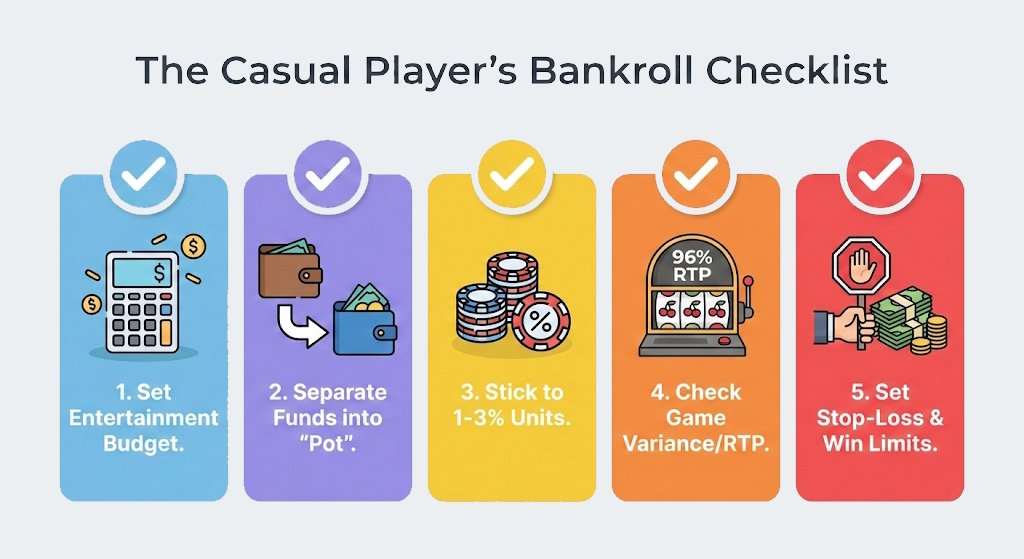
By following these rules, you move from being a reckless gambler to a disciplined player. You maximise your fun, minimise your financial risk, and ensure that win or lose, you remain in control.
Responsible Gambling Statement
Gambling should always be treated as a form of entertainment, not a way to make money. The strategies outlined above are designed to help you manage your funds, but they do not guarantee wins.
If you find that gambling is no longer fun, or if you are betting more than you can afford to lose, it is time to stop. There are free tools and support networks available to help you stay in control.
- Self-Exclusion: You can block yourself from all UK gambling sites for free using GAMSTOP.
- Blocking Software: Tools like BetBlocker can prevent access to gambling websites on your devices.
- Support & Advice: If you are concerned about your gambling, visit BeGambleAware for confidential help and support.
Stay informed and gamble safely. For more insights, contact us at info@thecasinocount.com.
Frequently Asked Questions (FAQ)
What is a good starting bankroll for a beginner?
There is no “correct” amount, but it must be money you can afford to lose 100% of. For many casual players, a bankroll of £50–£100 is sufficient to provide entertainment if you stick to low stakes (e.g., 10p or 20p spins). Never use money needed for essentials.
Does the Martingale strategy work for bankroll management?
No. The Martingale strategy involves doubling your bet after every loss. While it looks good on paper, it is dangerous. A short losing streak causes the required bet to skyrocket, hitting the table limit or bankrupting the player. We strictly advise against it.
How do I calculate my bankroll if I play table games like Blackjack?
The logic remains the same. If you have £100, your max bet per hand should be £1–£3. In Blackjack, you also need to account for “doubling down” or “splitting,” which requires extra chips. Therefore, a conservative 1% unit size is even more important in table games to cover these strategic moves.
Is it possible to make a living from online gambling?
For 99.9% of people, the answer is no. As mentioned in the “Cold Hard Truth” section, the vast majority of players lose money over time due to the house edge. Gambling should be viewed as a paid hobby, not a profession.
Why do I lose my profits so quickly?
This is usually due to a lack of a “Win Limit.” The longer you play, the more the mathematical house edge eats into your funds. If you do not withdraw when you are up, the casino will eventually win that money back. Learn to “hit and run.”





Leave a Reply