

Ever wondered if those digital casino games are truly fair, or if the house has more than just the usual edge? You’re not alone, so maybe it’s time to learn about RNG Casinos.
Every spin of the reels, every hand of blackjack, and every roll of the dice in online gambling is determined by something called a Random Number Generator (RNG). These complex algorithms are the backbone of virtual casinos, ensuring that outcomes are unpredictable—at least, in theory. At The Casino Count, we answer all of your questions, so be sure to check back regularly for more updates.
Highlights:
- At the core of every online casino game is a Random Number Generator (RNG), a sophisticated algorithm designed to produce sequences of numbers that appear completely unpredictable.
- Casino games favor the house – that’s no secret. But this advantage comes from transparent math, not rigged results.
- Few industries face stricter technical oversight than online gambling. Before you ever see a game, it’s been hammered by testing labs.
- The transparency bar keeps rising. Blockchain technology has introduced “provably fair” gaming where players can verify each result’s integrity
But how do they really work? Are they truly random, or is there a hidden pattern that gives casinos an even bigger advantage? More importantly, can players trust these systems to provide a fair gaming experience?
Let’s cut through the confusion and uncover what’s really happening behind the scenes of online gambling. If you want to learn more about interesting subjects and online gambling tips, be sure to subscribe to The Casino Count Blog.
The Tech Behind the Curtain
At the core of every online casino game is a Random Number Generator (RNG), a sophisticated algorithm designed to produce sequences of numbers that appear completely unpredictable. These numbers dictate every aspect of gameplay—from the outcome of a slot machine spin to the next card dealt in a game of blackjack. While they may seem like digital magic, RNGs follow strict computational principles to ensure fairness.
Online casinos typically rely on one of two types of RNG systems:
- Pseudo-Random Number Generators (PRNGs): These RNGs operate using complex mathematical formulas combined with seed values—initial numbers that set the pattern in motion. While PRNGs are technically deterministic (meaning that if you knew the seed and the exact algorithm, you could predict future numbers), the level of complexity involved makes this practically impossible. The calculations happen at such a rapid pace that even the most powerful computers would struggle to reverse-engineer them in real time.
- True Random Number Generators (TRNGs): Unlike PRNGs, which rely on math, TRNGs derive randomness from unpredictable physical processes, such as atmospheric noise, radioactive decay, or quantum fluctuations. These natural chaotic elements are then converted into digital data, ensuring genuine randomness that is impossible to replicate.
Most online casinos opt for PRNGs because they are faster, more cost-effective, and require less hardware. But don’t let that concern you—modern PRNGs generate thousands or even millions of numbers per second. The only number that matters is the one existing at the exact millisecond you place your bet or spin the reels. This ensures that the outcome of your game is as fair and unpredictable as possible.
Of course, fairness also depends on proper regulation. Reputable online casinos undergo rigorous testing by independent auditing firms to verify their RNGs function correctly, providing players with a fair and transparent gaming experience. So, while the casino always has an edge, the randomness of each game means that anything is possible—especially when luck is on your side!
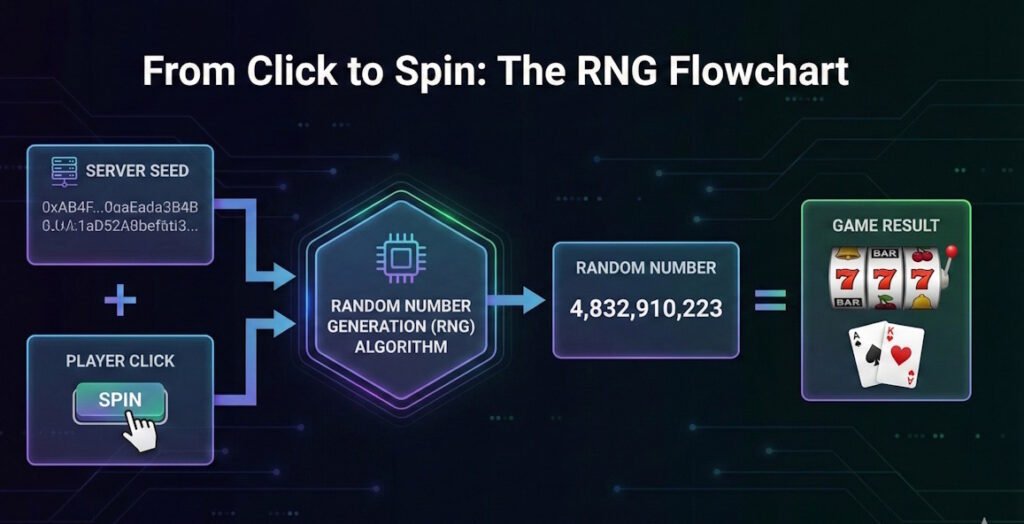
From Click to Spin: A Step-by-Step Technical Breakdown
While knowing that an algorithm exists is reassuring, understanding exactly what happens when you press ‘Spin’ removes the mystery. Here is the millisecond-by-millisecond process of a standard RNG cycle:
- The Constant Cycle: Even when no one is playing, the RNG software is running in the background, generating thousands of number sequences every second. It never sleeps.
- The ‘Seed’ Input: The algorithm takes a starting number (the seed) derived from an unpredictable source—such as the exact system time in milliseconds or even atmospheric noise measurements.
- The Player Action: The precise moment you click ‘Deal’ or ‘Spin’, the software freezes the sequence being generated at that exact nanosecond.
- The Mapping Process: The raw number generated (which might be something like 4,832,910,223) is mathematically divided to fit the specific game’s parameters. For a roulette wheel, it is converted to a number between 0 and 36.
- The Visual Display: The game interface then plays an animation (the wheel spinning or reels turning) to display the result that was actually determined the instant you clicked the button.
Key Takeaway: The animation is just for entertainment. The result is mathematically decided the moment your finger hits the mouse.
RNG vs. RTP: How Fairness and House Edge Coexist
A common question players have is: “If the numbers are random, how does the casino guarantee a profit?” This is where Return to Player (RTP) comes in.
The RNG ensures the outcome is random, but the payout odds are fixed.
- The RNG’s Job: To pick a number between 1 and 100 at random.
- The RTP’s Job: To decide that numbers 1–95 result in a loss, and 96–100 result in a win.
In this scenario, the game is fair (the numbers are truly random), but the math is structured so that over millions of spins, the casino retains a predictable percentage. The RNG provides the unpredictability of the journey, while the RTP dictates the mathematics of the destination.
Let’s Bust Some Myths
“The house is cheating you”
Casino games favor the house – that’s no secret. But this advantage comes from transparent math, not rigged results.
Take roulette: A European wheel gives the house a 2.7% edge because there are 37 possible outcomes but payouts are calculated as if there were 36. The RNG simply replicates these same odds digitally. The casino wins through mathematical certainty, not manipulation.
Looking to improve your skills in online casino games? Check out Beginner’s Corner: How To Play Online Casino Games.
“They flip a switch when you’re winning too much”
This myth doesn’t hold up under scrutiny. Licensed casinos can’t alter RNG outcomes on the fly because:
Their systems are architected to prevent it. Game outcomes and player accounts operate independently.
Regulators would shut them down immediately if caught.
The RNG typically determines results before your bet is even placed.
Testing labs constantly monitor for statistical anomalies.
Think about it – the risk of getting caught tampering would destroy a casino’s reputation and license. It’s simply not worth it when they’re already guaranteed profits through legitimate house edges.
“This slot is due for a payout”
Each spin is its own universe. What happened in the previous 50 spins has absolutely zero impact on what happens next.
This misconception stems from our brain’s tendency to find patterns where none exist. RNGs ensure each new result starts fresh, with no memory of past outcomes.
“Games pay less during busy hours”
Changing payout rates isn’t like adjusting the thermostat. It requires:
Regulatory approval Software recertification Often physical access to secured servers
Casinos can’t just dial down the winning during Friday night peak hours. Game parameters are hardcoded and heavily monitored.
Inside the Audit: How Games Are Actually Tested
Testing agencies like eCOGRA and iTech Labs do not just play the games for a few hours. They perform forensic digital analysis to certify an RNG. A typical certification process involves:
Source Code Verification: Auditors analyse the raw code to ensure there are no ‘backdoors’ or ‘cheat switches’ written into the software.
The ‘Diehard’ Battery of Tests: A suite of complex statistical tests designed to push the algorithm to its limits, looking for any repeating patterns or non-random clusters in the data.
Outcome Distribution Analysis: Running the game millions of times in a simulation to ensure the actual results match the theoretical RTP. If a slot claims a 96% RTP, the simulation must reflect that over a massive sample size.
If you want to learn more about RNG Casinos and Live Player options, check out Live Dealer Casinos Vs. RNG Casinos.
Protecting Yourself
You don’t need a computer science degree to spot fair games. Just look for:
- Valid licensing information prominently displayed Testing certificates from recognized labs Published RTP (Return to Player) percentages Solid reputation among gambling communities
- Be wary of casinos operating from sketchy jurisdictions or those with a history of payment problems. These red flags often signal deeper issues with game integrity.
What’s Next for Fair Play
The transparency bar keeps rising. Blockchain technology has introduced “provably fair” gaming where players can verify each result’s integrity themselves.
- Some cutting-edge approaches include:
- Players contributing to the randomization process Public blockchain records of game outcomes Smart contracts handling payouts automatically Live monitoring of actual return percentages
- AI systems now scan for statistical oddities that might indicate problems, adding another protective layer.
The Bottom Line
Here’s the reality: legitimate casinos don’t need to cheat. Their mathematical edge guarantees profit over time. Rigging games would risk everything for negligible gain.
Modern RNG systems, backed by testing and oversight, deliver randomness comparable to physical casinos. While no one can guarantee you’ll win, you can be confident that certified games aren’t stacking the deck beyond their advertised house edge.
The greatest gambling myth? That casinos need to cheat to win. The truth is far simpler: probability math already ensures their advantage with every play.
While the Random Number Generator is the mathematical heartbeat of fair play, it is merely one component of a fully secure gambling environment. To truly play with confidence, you must understand how these algorithms work in tandem with valid licensing and strict data protection protocols to guarantee your safety. For the complete picture on how these technical elements combine to protect you, read our comprehensive resource: Your Guide to Fair & Safe Online Gambling.
Play for entertainment, not income. Gamble responsibly and remember that every casino game includes a mathematical house advantage.
Frequently Asked Questions (FAQs)
Can a casino change the RNG settings during a game?
No. In licensed jurisdictions (like the UK or Malta), the RNG is hosted on a secure server often controlled by the game provider, not the casino operator. The casino cannot access the code to alter outcomes.
Does ‘Provably Fair’ mean standard RNG is unfair?
Not at all. Standard RNG (audited by labs like eCOGRA) is fair and secure. ‘Provably Fair’ is simply a different method often used in crypto casinos that allows players to verify the randomness manually using blockchain hashes, whereas standard RNG relies on third-party certificates.
If I play a slot for hours without winning, is the RNG broken?
Unlikely. True randomness allows for ‘clumping’. Just as you could flip a coin heads 10 times in a row, an RNG can produce losing streaks. The memory-less nature of the software means it does not know you have been losing and does not ‘owe’ you a win.
What is the difference between PRNG and TRNG?
PRNG (Pseudo-Random Number Generator) uses mathematical algorithms and is used for virtual games because it is fast. TRNG (True Random Number Generator) uses physical phenomena (like atmospheric noise) and is often used for cryptography or generating the initial ‘seed’ for the PRNG.






Leave a Reply to Buy Website Backlinks Cancel reply